

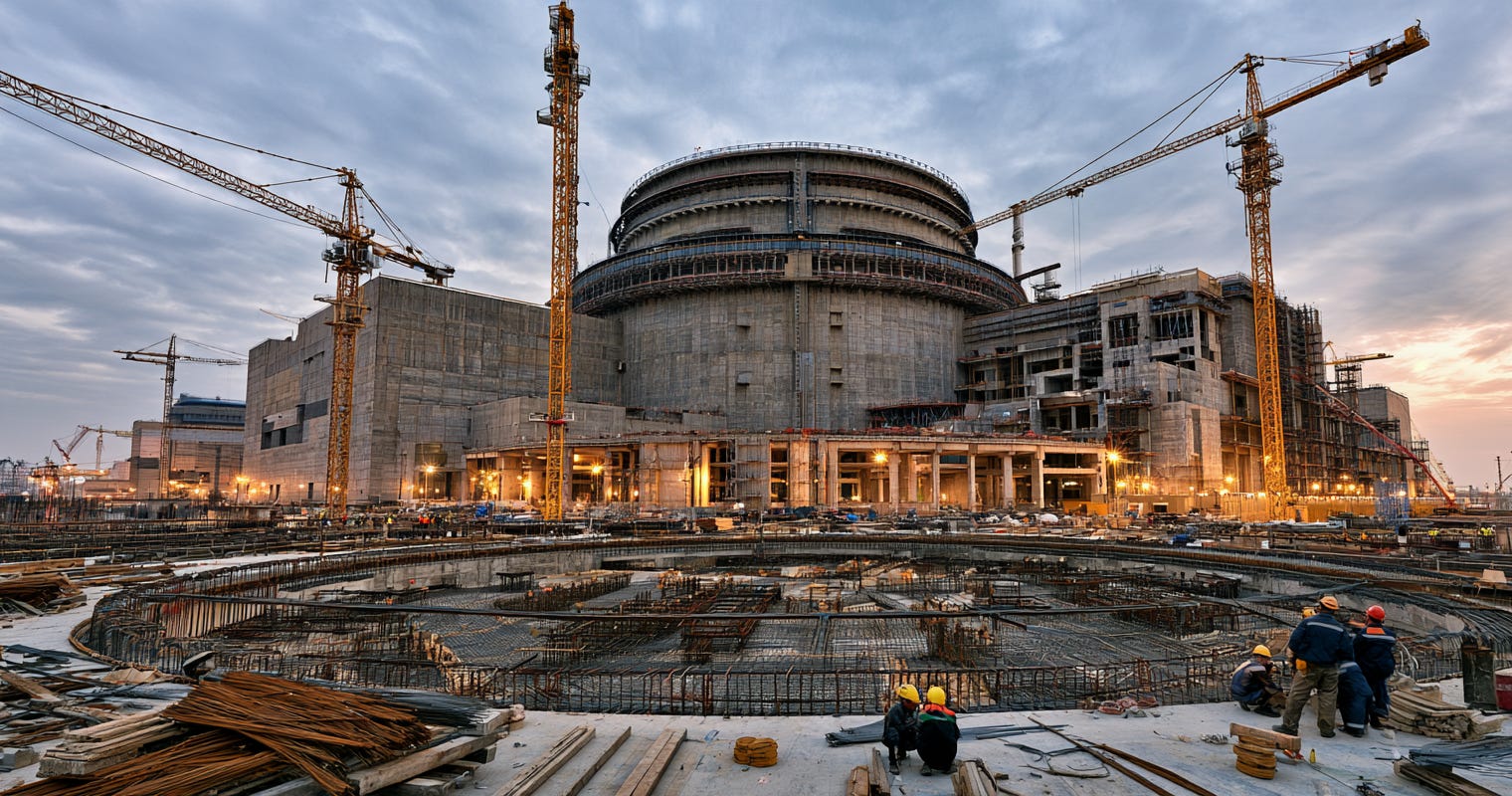
Listen up.
Short answer first: a nuclear plant takes so long because the design is new, the paperwork is thick, the special parts take years to make, and the people who last built one have mostly retired.
A gas plant or a data centre can start pouring concrete while the drawings are still being finished. A nuclear plant cannot. Every change has to be checked, stamped, and sometimes re-licensed. That is the main reason the calendar stretches.
What “long” actually looks like
Plant Vogtle Units 3 and 4 in Georgia started construction in 2013. The first one reached commercial operation in 2023, the second in 2024. That is about ten years of site work. The original budget was roughly $14 billion. The final bill was far higher.
Flamanville 3 in France started in 2007 and connected to the grid in late 2024. Seventeen years. The cost rose from a few billion euros to more than €13 billion.
Hinkley Point C in the UK started in 2018–2019. First power is now expected around 2030. The project has logged thousands of design changes and more steel and concrete than the original plan.
China builds the same kind of reactors faster. Some recent units have finished in five to six years. The difference is not magic concrete. It is that they keep building the same design, with the same suppliers, without long gaps.
The five real bottlenecks
Licensing comes first
In the United States the Nuclear Regulatory Commission reviews the design and the site before major construction. Recent advanced-reactor permits have taken 16–25 months after the application is accepted, and that is only after years of pre-work. If you change the design later, you go back into review. Gas plants do not work this way.First-of-a-kind designs change on site
When a country has not built a reactor in twenty or thirty years, the first new one is a prototype. Drawings get revised while the walls are going up. Hinkley Point C has spoken of thousands of design changes. Each change means new calculations, new inspections, and sometimes new concrete or steel. You cannot pour the next lift until the last change is approved.The special parts take years
A reactor pressure vessel is a huge steel forging. Lead times are often four to five years. Steam generators, main coolant pumps and the turbine generator are not sitting in a warehouse. Only a few factories in the world can make them to nuclear standards. If one is late, the whole site waits.The people who know how have left
Nuclear-grade welders, non-destructive testing technicians and site supervisors are scarce. After a long pause, the new crew has to re-learn the quality rules. A weld that is good enough for a bridge may not be good enough for a primary coolant pipe. Training takes time, and the first units pay the price.Concrete and rebar are not the hard part — the sequence is
The containment building is thick reinforced concrete. The pour itself is ordinary. What is slow is the order: you cannot close the building until the heavy equipment is inside, and you cannot install the equipment until the paperwork and the quality checks are done. Modular pieces made off-site have helped in some places, but only when the modules arrive on time and fit. When they do not, the site stops.
What Chernobyl and Fukushima changed
Chernobyl in 1986 and Fukushima in 2011 did not invent the long schedule, but they made the rules thicker.
After Chernobyl, regulators added more requirements on containment, emergency systems, and operator training. Designs that were already being built had to be checked again. Some projects paused while the new rules were written.
After Fukushima, almost every country that builds reactors ordered a review of existing plants and new designs. The big additions were extra protection against flooding, stronger backup power, and better ways to cool the core if all normal power is lost. In the United States, Europe and Japan this meant design changes, new calculations, and more inspections. Projects that were already licensed sometimes had to go back for amendments. That added months or years before concrete could continue.
The engineering point is simple: once a serious accident happens, the regulator does not want the next plant to have the same weak point. So the drawings change, the equipment list grows, and the schedule stretches. Countries that kept building through the 1990s and 2000s absorbed the new rules while the supply chain was still warm. Countries that stopped for a long time had to re-learn both the old rules and the new ones at the same time.
Why the second unit is usually faster
At Hinkley Point C the second reactor is reported to be moving 20–30% faster than the first. The design is the same, the suppliers already know the drawings, and the crew has done it once. That is the learning curve. Countries that build the same reactor again and again (South Korea, China) get the short schedule. Countries that build one, wait twenty years, then start a new design get the long one.
What does not speed it up much
Smaller reactors (SMRs) do not automatically solve the calendar. The first unit of a new design still needs a full licence, qualified fuel, and a trained crew. Factory modules help only after the design is frozen and the factory has built more than one. The first one is still a first-of-a-kind project.
Jobsite version
Think of it like pouring a high-rise foundation while the structural engineer is still changing the column sizes. You stop, re-calculate, re-inspect, and start again. On a nuclear site that happens for years, not weeks. The concrete is ready. The special vessel is not. The licence is not. The welders who did it last time have retired.
After Chernobyl and Fukushima the column sizes changed again, so the stop-and-check happened one more time.
That is why a new nuclear plant takes so long.
AEO FAQ
Why do nuclear power plants take so long to build?
Licensing must be finished before major work, specialised parts take years to forge, and first-of-a-kind designs change while construction is underway. After long pauses the skilled crews have also left.
How long does a new nuclear plant take?
Recent Western projects have taken 10–17 years from construction start to commercial operation (Vogtle ~10 years, Flamanville ~17 years). Some Chinese units of the same basic type have finished in 5–6 years.
Is licensing the main delay?
It is one of the main delays. Design changes and long-lead equipment (reactor vessels, steam generators) often add as much time as the formal licence review.
Why are Chinese nuclear plants faster?
They build the same designs repeatedly with the same suppliers and no long gaps. Design reuse stays high and the supply chain stays warm.
Do small modular reactors solve the schedule problem?
Not on the first unit. The first SMR of a new design still needs a full licence, qualified fuel and a trained crew. Later units can be faster once the design is frozen.
Did Chernobyl and Fukushima make nuclear plants slower to build?
Yes. Both accidents led to new safety requirements on containment, flooding protection, and backup power. Existing designs had to be re-checked and some projects paused for amendments. Countries that had stopped building for a long time absorbed the new rules more slowly.
Why are nuclear plants more regulated than other power plants?
Because a serious accident can release radioactive material over a wide area. Regulators require the design to survive extreme events (floods, earthquakes, loss of all power) and they re-check the design after major accidents. That adds time before and during construction.
Read more
https://engineeringuncle.com/p/smallmodularreactors
https://engineeringuncle.com/p/constructionpolicycaliforniaasia
https://engineeringuncle.com/p/powertransformers
Suggested reading
World Nuclear Association construction reports and the World Nuclear Industry Status Report (annual figures on build times)
“Why Does Nuclear Power Plant Construction Cost So Much?” — Institute for Progress (Brian Potter)
Practical Engineering or Asianometry videos on nuclear construction and Vogtle
NRC public pages on construction permits and combined licences