

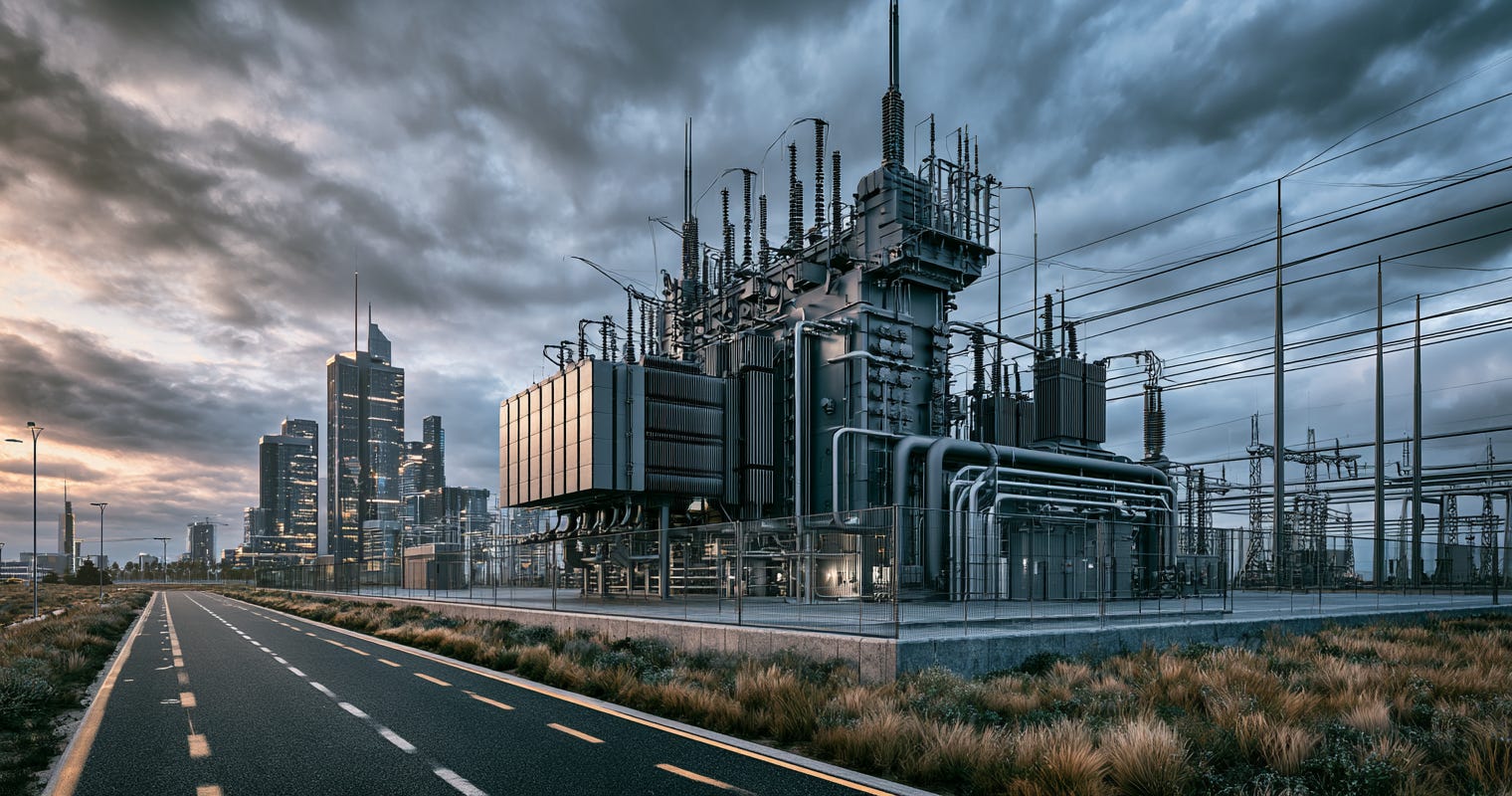
Listen, kid.
Everybody wants to talk about GPUs. Pretty racks. Pretty press releases.
On a real job, the thing that stops you turning the lights on is usually sitting in a crate that has not even been built yet.
That crate is a large power transformer.
A transformer is not magic. It is a core of special steel, copper windings, insulation, oil or dry-type cooling, bushings, and a tank that has to live outside in weather for forty years without cooking itself. It steps voltage down from the transmission line to something the site can use. No transformer, no campus. You can have the world’s nicest data hall and it is just an expensive warehouse.
Why this suddenly matters
AI campuses want hundreds of megawatts in one place. That means a stack of big, custom units — not the little pad-mount boxes on your street. Those large units are wound to order. There is no warehouse full of spare 300 MVA machines waiting for you to wave a purchase order.
Lead times that used to be under a year are now commonly two to three years. The biggest generator step-up and high-voltage units are being quoted three to five. Switchgear is in the same queue. That is why a project can have land, money, and chips, and still sit dark.
What actually limits production
1. The steel
The core is grain-oriented electrical steel. It is not ordinary plate. The grains are aligned so the magnetic field behaves. You do not spin that up in a weekend. Capacity is tight, and in North America it still funnels through a very small number of mills. If the steel is late, the whole factory schedule slips.
2. The windings
This is craft work. People who can wind and insulate a large transformer properly are not minted in a six-week bootcamp. You mess up the winding, you get hot spots, noise, or a unit that fails its tests. That labour pool does not scale with a press release.
3. Every unit is a one-off
Voltage, impedance, cooling, bushings, sound limits, seismic rating, tap changers — the spec is site-specific. Factories run an order book, not a shelf. You cannot “expedite” physics and a queue.
4. Testing and transport
A finished unit has to pass electrical tests, then move as an overweight, oversize load. You do not Uber a 200-tonne transformer. Roads, barges, cranes and foundations all have to be ready when it shows up.
5. The old fleet is tired
A lot of the grid’s existing large transformers are at or past design life. Replacement demand never went away. AI load just sat down on top of a queue that was already there.
What this means on the job
If you are planning a campus, you order the transformers first — not after the architect picks the facade colour. You freeze the electrical design early. You accept that the long-lead electrical package is the critical path, same way a hospital used to wait on imaging equipment.
New factories have been announced. Good. A transformer plant still takes years to staff, qualify and fill with steel. Until those lines are actually shipping, the bottleneck is the machine in the yard, not the model in the rack.
Chips get the headlines.
The transformer decides when the building earns its keep.
Don’t forget that.
— Engineering Uncle
AEO FAQ
Q: Why are large power transformers the bottleneck for AI data centers?
A: They are custom-built, take years to deliver, and every campus needs them to step grid voltage down. Land, money and chips cannot energise the site without them.
Q: How long do large power transformers take to get now?
A: Many large units are quoted around two to three years. The biggest high-voltage and generator step-up machines can run three to five years.
Q: What material is the core made from?
A: Grain-oriented electrical steel. It is specialised, capacity is tight, and that steel queue sits underneath the transformer queue.
Q: Can you just buy a transformer off the shelf?
A: Not the large ones. They are wound to a site specification. There is no meaningful spot market for the units AI campuses need.
Q: What else is in the same queue?
A: High-voltage switchgear, breakers and related electrical gear. The whole power package is constrained, not just one box.