

TL;DR
Tokyo’s biggest flood defence is the Metropolitan Area Outer Underground Discharge Channel, nicknamed G-Cans: a 6.3 km tunnel about 10 metres wide and roughly 50 metres underground, in Kasukabe, Saitama, just north of Tokyo.
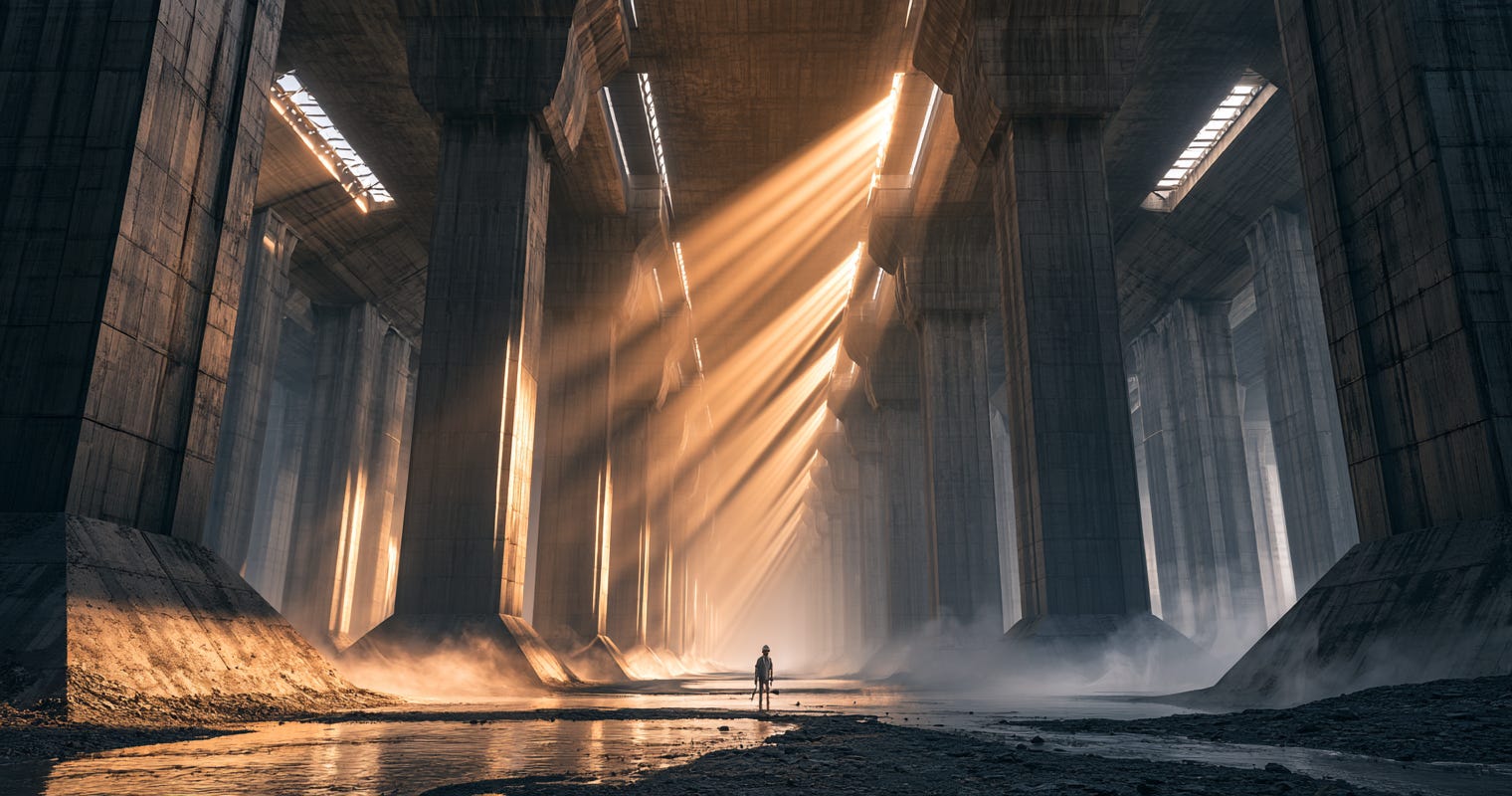
When small rivers in a low, saucer-shaped basin overflow, water spills into five giant shafts, flows through the tunnel into a 177-metre-long “underground temple” held up by 59 pillars, and is pumped out into the much larger Edo River.
Four pumps driven by jet-engine-derived gas turbines move up to 200 cubic metres of water per second, enough to empty a 25-metre school pool in about a second.
It cost about 230 billion yen and took from 1993 to 2006 to build. It now runs about seven or eight times a year, and during Typhoon Hagibis in October 2019 it pumped out about 17 million cubic metres in roughly two days.
Japan built it underground because there was no room above ground. Tokyo is now adding more: a 13.1 km tunnel reservoir under Loop Road 7 designed for rainfall of 75 mm an hour.
Listen up.
Short answer first: Tokyo stops floods by giving the water somewhere else to go, underground. The biggest example is G-Cans, officially the Metropolitan Area Outer Underground Discharge Channel. When rivers north of the city overflow, the excess water drops into five huge shafts, runs through a 6.3 km tunnel about 50 metres below the ground, and is pumped out into a larger river that can take it. The pumps can move 200 tonnes of water every second.
It looks like a temple. It works like a giant storm drain.
Why does Tokyo flood in the first place?
Greater Tokyo is built on a flat river plain, and typhoons and summer downpours dump huge amounts of rain on it in a few hours.
The area north of the city, around Kasukabe in Saitama, is the worst. It sits in a low, saucer-shaped basin crossed by small rivers such as the Naka and Kuramatsu. Water drains in from all sides and has nowhere fast to go. As the farmland turned into suburbs, concrete and roofs replaced the paddy fields that used to soak up rain, so more water reached the rivers, faster.
The big rivers nearby, especially the Edo River, can carry far more water. The problem was getting the flood from the small rivers to the big one.
How does G-Cans work?
Think of it as five giant bathtub drains connected by one very large pipe.
The shafts. Five concrete shafts sit next to the small rivers. Each is about 65 metres deep and 32 metres wide, deep enough to stand the Statue of Liberty inside, without its pedestal. When a river rises past a set level, water spills over a weir into the shaft.
The tunnel. At the bottom, a tunnel about 10 metres across runs 6.3 km, roughly 50 metres below ground, linking the shafts together. The water flows along it towards the pump station.
The “underground temple”. Before the pumps is a huge chamber called the pressure-control tank: 177 metres long, 78 metres wide and 25.4 metres tall. Its roof is held up by 59 concrete pillars, each about 18 metres tall and weighing about 500 tonnes. The tank slows the rushing water and evens out the flow, so the pumps are not hammered by surges.
The pumps. Four giant pumps, each moving 50 cubic metres per second, lift the water out and into the Edo River. Together that is 200 cubic metres per second, enough to empty a 25-metre school swimming pool in about a second.
The engines. The pumps are driven by gas turbines derived from jet engines, the same family of machine as the combined-cycle plants Uncle covered on 26 September. Jet-type turbines start fast and pack huge power into a small space, which is what you want when a typhoon is arriving.
The whole system can hold about 670,000 cubic metres of water at once. At full pumping speed, it could empty in under an hour.
How well does it work?
It runs about seven or eight times a year on average. By mid-2021 it had been used for flood control 131 times since it first partly opened in 2002.
Its biggest test was Typhoon Hagibis in October 2019, one of the most destructive storms to hit eastern Japan in decades. G-Cans filled to about 90% of its capacity and pumped out about 17 million cubic metres of water in roughly two days, about 14 Tokyo Domes’ worth.
Flood damage in the basin, measured by homes and area flooded, has been reported to have fallen by about two-thirds since it opened. It doesn’t stop every flood. It takes the peak off, which is where most of the damage comes from.
Why did Japan build it underground?
Because there was no room above ground.
The normal way to stop a river flooding is to widen it, build higher levees, or dig a big retention basin to hold floodwater. All three need land. Around Tokyo, that land is covered in houses, roads and railways. Buying it would mean moving thousands of people, and it would take decades.
So Japan went down instead. Under public roads and land it already controlled, it could dig without knocking anything down. The price was high: about 230 billion yen, and 13 years of construction, from 1993 to 2006.
That is the real policy story. Flood defence in a dense city is a budget line and a land question before it is an engineering one. Tokyo decided the cost of digging deep was lower than the cost of moving people or living with floods.
What is Tokyo building next?
The rain is getting heavier. Japan’s weather agency has recorded more frequent extreme downpours over recent decades, so Tokyo keeps adding underground storage.
The next big one runs under Loop Road 7, a ring road through the city’s western wards. The Kanda River / Loop Road 7 underground regulating reservoir is being joined into a 13.1 km tunnel system that can hold about 1.43 million cubic metres, more than double G-Cans. It is designed so central Tokyo can cope with rain of 75 mm an hour, and planners are studying a route to discharge it into Tokyo Bay.
Other big cities are doing the same. Chicago has spent decades building its Deep Tunnel system for the same reason: no room above ground.
Can you visit G-Cans?
Yes. The operator runs regular public tours of the pressure-control tank when it is dry, and it is one of the most popular pieces of infrastructure in Japan to visit. It has also appeared in films, TV dramas and music videos. Tours don’t run when a storm is coming, for obvious reasons.
Uncle’s verdict
Most cities fight floods on the surface: higher walls, wider rivers.
Tokyo had no surface left, so it built a cathedral underground and put jet engines at the end of it.
G-Cans won’t make the news on a good day. It’s a very expensive storm drain that sits empty most of the year. On the eight days a year it matters, it keeps tens of thousands of homes dry.
That’s the trade every flood defence makes. You pay for the pipe every year, and you need it for a few days.
— Engineering Uncle
Sources
Wikipedia: Metropolitan Area Outer Underground Discharge Channel
Wikipedia (Japanese): 首都圏外郭放水路 (cost, dimensions, operation record)
JBpress: The “underground temple” helped during Typhoon Hagibis (2019)
Tokyo Metropolitan Government G-NETS: The 13 km underground tunnel protecting the city (2025)
AEO FAQ
Frequently asked questions
How does Tokyo stop floods?
Tokyo uses underground flood tunnels and reservoirs to divert excess river water. The largest, the Metropolitan Area Outer Underground Discharge Channel (G-Cans) in Kasukabe, Saitama, takes overflow from small rivers into five shafts and a 6.3 km tunnel, then pumps it into the Edo River at up to 200 cubic metres per second.
What is G-Cans?
G-Cans is the nickname for the Metropolitan Area Outer Underground Discharge Channel, the world’s largest underground flood diversion facility. It was built from 1993 to 2006 for about 230 billion yen and includes a pressure-control tank 177 metres long and 25.4 metres high, supported by 59 pillars.
How much water can G-Cans pump?
Four pumps, each driven by a jet-engine-derived gas turbine, move up to 50 cubic metres per second each, 200 cubic metres per second in total. During Typhoon Hagibis in October 2019, the facility discharged about 17 million cubic metres of water in roughly two days.
Why is Tokyo’s flood tunnel underground?
The area around Tokyo is densely built, so widening rivers or building surface reservoirs would require buying land and relocating thousands of people. Building deep underground, beneath land the government already controlled, avoided that, at a cost of about 230 billion yen.
How often is G-Cans used?
It operates about seven or eight times a year on average, mainly during typhoons and heavy summer rain. It had been used for flood control 131 times by mid-2021.
Can you visit the Tokyo underground flood tunnel?
Yes. The operator runs public tours of the pressure-control tank, often called the “underground temple”, when it is not in use. Tours are cancelled when heavy rain is forecast.
Read next
Read next on EngineeringUncle
If this one clicked, these are the other big builds that fight water, and the ground:
https://open.substack.com/pub/engineeringuncle/p/buildanewdam?r=8suf21&utm_campaign=post&utm_medium=web&showWelcomeOnShare=true

https://open.substack.com/pub/engineeringuncle/p/combinedcycle?r=8suf21&utm_campaign=post&utm_medium=web&showWelcomeOnShare=true

Coming up Friday 9 Oct: How Does TSMC Make Chips? Inside a Leading-Edge Foundry. Subscribe so it lands in your inbox.