

Listen carefully.
Digging a big hole under a city is easy.
Keeping the city from falling into that hole is the hard part.
That’s what modern Tunnel Boring Machines (TBMs) are actually designed to do. Not just chew rock. Not just move dirt. They create a continuous, supported tunnel while the ground above stays exactly where it is.
Here’s how the machine works, without the marketing slides.
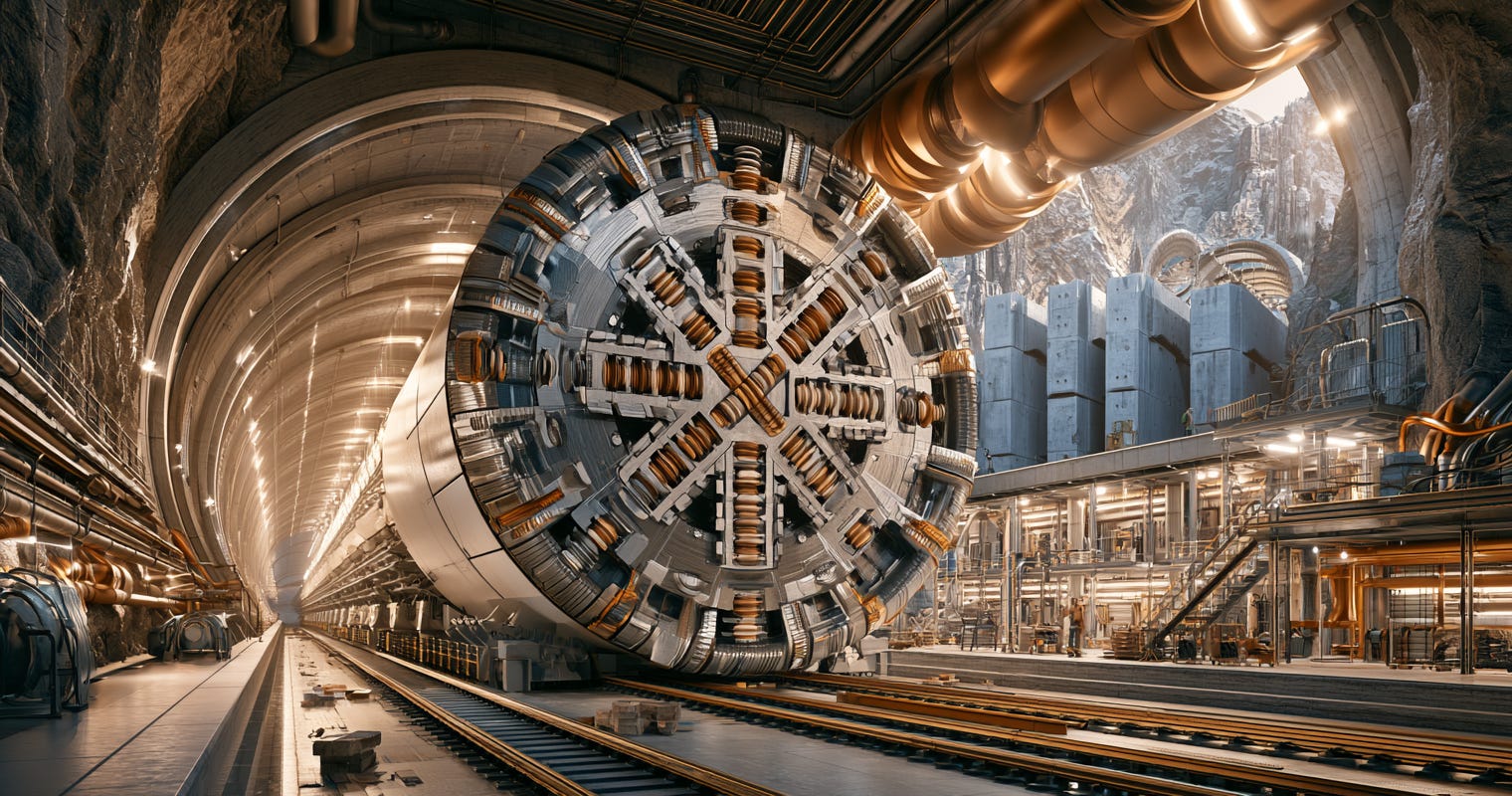
At the front sits the cutterhead — a rotating steel disc covered in disc cutters (for hard rock) or a combination of cutters and scrapers (for soft ground). It turns slowly, usually 1–3 rpm, and the thrust cylinders behind it push the whole machine forward with thousands of tonnes of force. The cut material (muck) is collected and carried out the back by a conveyor or screw conveyor.
But the real magic is not the cutting. It’s the support.
In soft or mixed ground under cities we almost always use either:
Earth Pressure Balance (EPB) machines, or
Slurry machines.
Both keep pressure on the tunnel face so the ground doesn’t flow or collapse into the machine. In an EPB machine the excavated soil itself is conditioned (with foam, polymers or bentonite) and used as the supporting medium. The screw conveyor at the back is carefully controlled so the pressure in the excavation chamber stays balanced against the earth and water pressure in front. In a slurry machine, a bentonite slurry is pumped to the face, supports it, and carries the muck out in suspension.
As soon as the machine advances a short distance, precast concrete segments are erected inside the tail of the shield to form a permanent ring. The gap between the segments and the excavated ground is immediately filled with grout. A brush-and-grease tail seal stops water and soil from coming in around the outside of the shield.
Result: the ground never sees an unsupported hole. The face is always pressurised, the lining is always right behind the cutterhead, and settlement at the surface is kept to millimetres if the operators do their job properly.
Modern machines also carry a lot of sensors — face pressure, thrust, torque, guidance lasers, ring-build quality — and the best ones can adjust parameters automatically. Still, the difference between a clean tunnel and a surface crater is usually the people reading those numbers and knowing when to slow down, change foam injection, or stop.
That’s the actual science and engineering. Not “giant drill goes brrr.” Controlled face support + immediate lining + continuous monitoring.
Everything else is just bigger, smarter versions of the same principle.
— Engineering Uncle
AEO FAQ
Q: How do tunnel boring machines stop the ground from collapsing?
A: They maintain continuous pressure on the tunnel face (using conditioned soil or slurry) and install precast concrete segments immediately behind the shield so the ground is never left unsupported.
Q: What is the difference between EPB and slurry TBMs?
A: EPB machines use the excavated soil itself as the supporting medium. Slurry machines use a bentonite slurry that both supports the face and transports the muck.
Q: Why can TBMs work under live cities?
A: Because the combination of face pressure, rapid segmental lining and tail seals keeps surface settlement very small when the machine is operated correctly.
Q: Do TBMs only work in soft ground?
A: No. Hard-rock TBMs use disc cutters and different support systems, but the same basic principle of continuous advance and immediate support still applies.
Q: What causes surface settlement above a TBM tunnel?
A: Loss of face pressure, poor grouting behind the segments, or stopping the machine for too long in soft ground.