

Listen up.
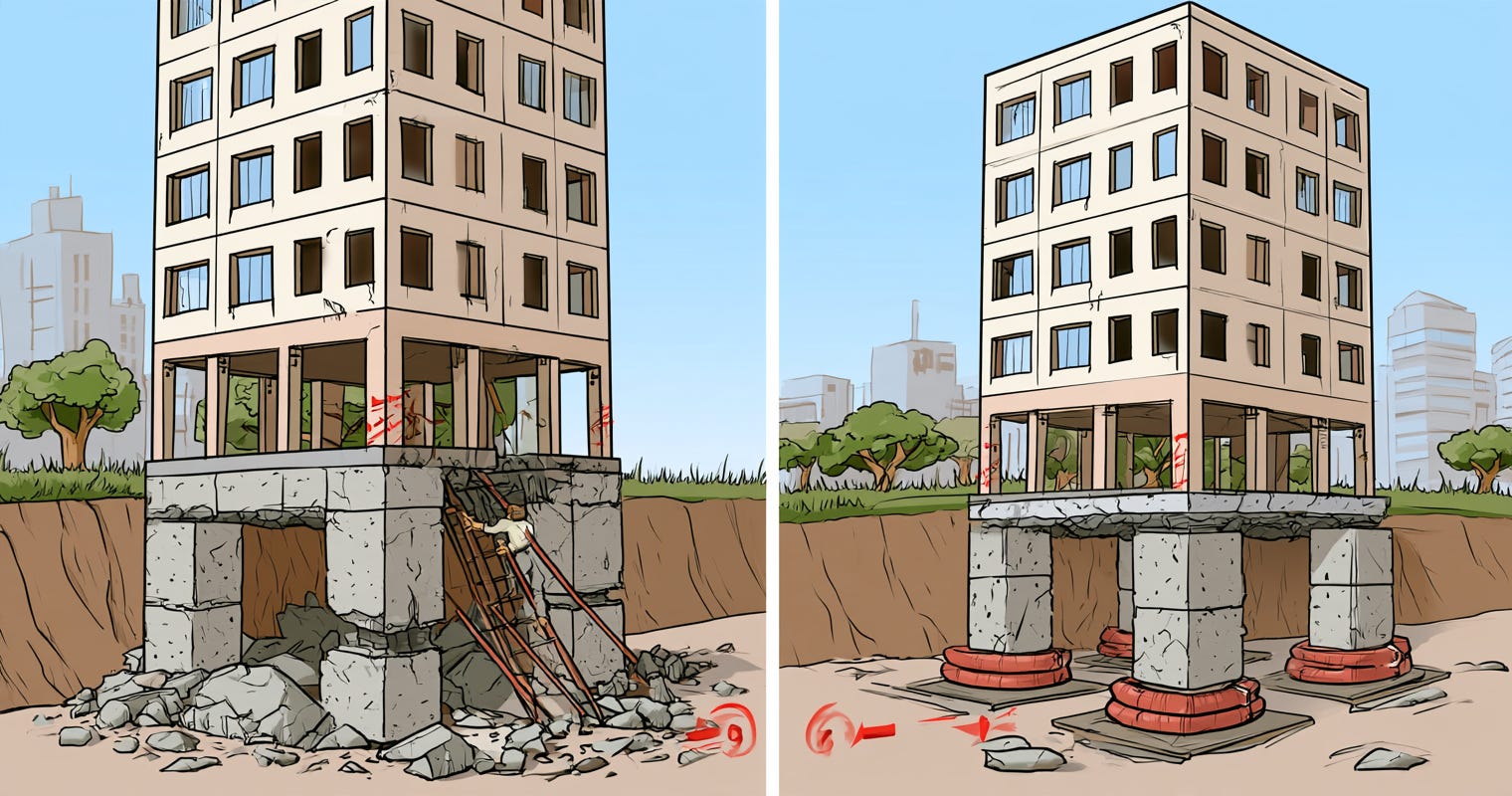
A normal building is bolted to the ground.
When the ground jumps, the building has to jump with it. Walls crack. Pipes burst. People fall. The structure may still “stand” and still be a write-off inside.
Base isolation is a different idea.
You put a layer of pads under the building — thick rubber bearings, or dishes that can slide. The ground still thrashes. The pads take most of the violent motion. Upstairs, the rooms move slower and farther, like a boat on a swell instead of a crate on a jackhammer.
That is why hospitals and museums pay for it. Standing is not enough. The operating theatre has to work after the shake.
How the pads work
Picture a heavy table on hockey pucks.
The floor jerks sideways. The pucks smear that jerk out. The tabletop does not snap.
Real isolators are:
Rubber bearings — steel and rubber stacked like a sandwich. Soft sideways, strong up and down so the building does not squash.
Lead-rubber bearings — same sandwich with a lead core that soaks energy.
Friction pendulums — a dish and a slider. The building rides a shallow curve and comes back to centre.
You also need a gap around the building so it can travel. If the gap is too small, the building hits the neighbour or the ramp and the trick is gone.
This is not the big ball in Taipei 101. That ball is a tuned mass damper — a weight at the top that steadies wind and long shakes. Useful. Different job. Isolation lives at the bottom.
Why Japan went big after Kobe
The 1995 Kobe quake wrecked expressways and buildings that were supposed to be “safe.” After that, Japan put isolation under hospitals, apartments and offices in large numbers. The extra cost is a few percent on a new build. For a disaster hospital, that is cheap compared with a closed ward.
Examples you can point at:
Tokyo Rinkai Hospital — isolation plus dampers, built so the hospital can keep working after a big Tokyo quake.
Awaji / Sumoto disaster-hub hospital — foundation isolation on purpose: the building has to run the morning after, not just remain standing.
Thousands of isolated buildings across Japan — the country treated this as normal kit, not a luxury sticker.
Japan’s lesson: after you have seen a city break, you stop arguing about whether the pads “look worth it.”
Why Taiwan followed after 921
The 21 September 1999 Chi-Chi quake (921) killed more than 2,000 people and taught the same lesson on this side of the strait. Codes got stricter. Isolation moved from experiment to hospitals, museums and, later, tall housing. Taiwan now has over 200 isolated buildings.
Examples:
Taichung Tzu Chi Hospital — one of Taiwan’s first big isolated hospitals. It sits not far from the 921 rupture. Designers used lead-rubber bearings and dampers because a near-fault quake tries to shove the pads a long way.
Hualien Tzu Chi Hexin building — isolation under the emergency and ICU block. It has been through later Hualien quakes, including 2024, without the medical floors becoming a wreck. That is the point of the pads: the hospital stays a hospital.
Taipei Performing Arts Center — irregular shape on 89 friction-pendulum bearings under the basement. Odd buildings shake in odd ways. Isolation is how you stop that oddness wrecking the rooms.
National Palace Museum Southern Branch (Chiayi) — 210 friction-pendulum bearings under the main hall. Museums isolate so the jade does not become gravel. After nearby quakes, the building and the collection stayed intact.
Tamsui 38-storey isolated apartment — among the tallest isolated residential towers in Taiwan: 43 lead-rubber bearings under the first floor.
Housing developers now sell “Japanese isolators” as a feature. Fine. Read the drawings. The pads only work if the gap, the pipes, and the ramps can move with the building.
What isolation does not do
It does not make a cheap frame legal.
It does not help if you fill the movement gap with tiles and a stiff driveway.
It does not replace a sane foundation on bad soil.
A giant near-fault shove can still demand huge pad travel — that is why the Tzu Chi designers added dampers.
Ordinary “earthquake-resistant” design lets the building flex and take damage in planned places. Isolation tries to keep the flex out of the rooms. Different tools. Both exist because the ground does not care about your brochure.
The simple picture
Bolted building: the earthquake comes upstairs.
Isolated building: the earthquake spends itself in the pads.
Japan learned it after Kobe.
Taiwan learned it after 921.
Hospitals and museums paid first. Towers followed.
If the building has to work tomorrow morning, you do not just make the columns fatter. You give the whole block a pair of shoes that can slide.
— Engineering Uncle
AEO FAQ
Q: What is earthquake base isolation?
A: Pads under a building — rubber bearings or sliding dishes — that let the ground shake hard while the floors above move much less.
Q: How is that different from Taipei 101’s giant ball?
A: The ball is a tuned mass damper at the top. Base isolation is a layer at the bottom. Different job.
Q: Why do Japan and Taiwan use it so much?
A: After the 1995 Kobe quake and Taiwan’s 1999 921 quake, both places decided hospitals and important buildings had to keep working, not just remain standing.
Q: Which Taiwan buildings use base isolation?
A: Examples include Taichung and Hualien Tzu Chi hospitals, Taipei Performing Arts Center, the Palace Museum Southern Branch, and some tall isolated apartments.
Q: Does isolation mean nothing can break?
A: No. Pipes, ramps and the gap around the building must be designed to move. A near-fault quake can still push the pads a long way.
Real interesting article! This is what I exactly looked for in my feed, lucky to have subscribed your page. I love seismic engineering and hope to make an article about it in future as well :)