

Listen up.
Short answer first: a nuclear power plant is a fancy way to boil water.
The industrial revolution ran on boiling water. Coal heated a boiler. Steam pushed a piston or spun a turbine. The turbine turned a generator. Electricity came out. A nuclear plant does the same job. The only difference is what makes the water hot.
Where the heat comes from
Inside the reactor core are fuel assemblies made of uranium pellets. When a neutron hits a uranium atom, the atom splits. That is fission. The split releases heat and more neutrons, which split more atoms. The chain reaction is controlled so it stays steady.
The heat is intense. A typical large reactor produces about 3,000 megawatts of heat to make roughly 1,000 megawatts of electricity. Most of the heat does not become electricity. That is normal for any steam plant.
Two ways to boil the water
Most plants use one of two designs.
Pressurized water reactor (PWR)
The water that touches the fuel is kept under very high pressure — about 150 times atmospheric pressure. It gets hot (around 300 °C) but does not boil. That hot water flows through thousands of tubes inside a steam generator. On the other side of the tubes is ordinary water at lower pressure. That water boils and makes steam. The radioactive water never leaves its closed loop. The steam that goes to the turbine is clean.
Boiling water reactor (BWR)
The water that touches the fuel is allowed to boil inside the reactor vessel. The steam rises, is dried, and goes straight to the turbine. There is no separate steam generator. The design is simpler, but the steam that reaches the turbine has passed through the core, so the turbine side needs more shielding.
Both designs end at the same place: steam.
What the steam does
The steam hits the blades of a turbine. The turbine spins. It is connected to a generator. The spinning magnet inside the generator pushes electrons through the wires. That is electricity.
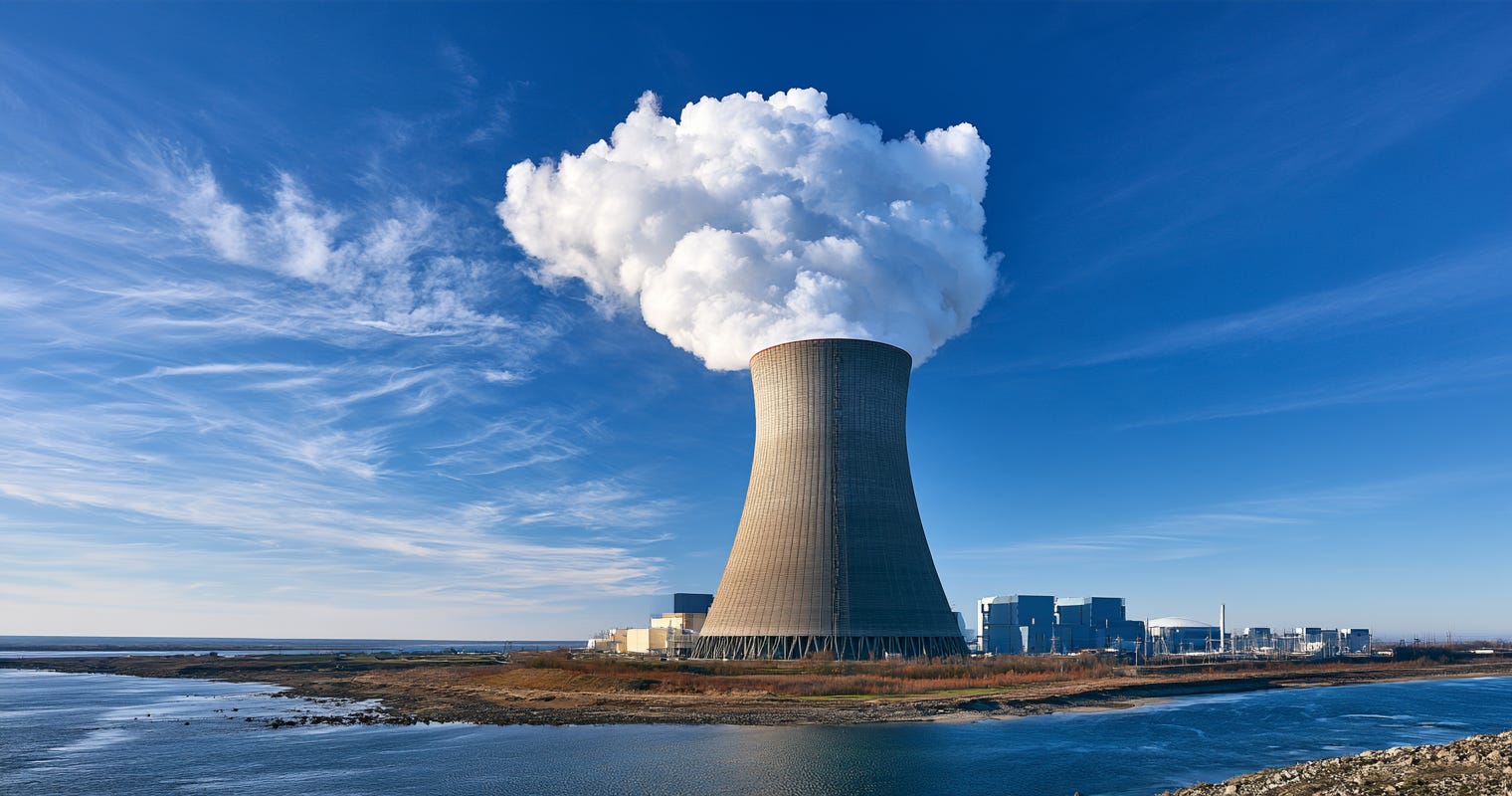
After the turbine the steam is cooled back into water in a condenser. The water is pumped back to be heated again. The cycle repeats. The big cooling towers you see in photos are usually cooling the condenser water, not the reactor itself. The white cloud is water vapour, not smoke.
Why it is only about one-third efficient
A modern nuclear plant turns roughly one-third of the heat into electricity. The rest is rejected in the condenser. That is the same basic limit any steam plant faces. Hotter steam would be more efficient, but the materials and the pressure vessel can only handle so much. Gas plants that use a combined cycle (gas turbine plus steam) do better because they start hotter. Nuclear stays at about 33 %.
The containment building
Around the reactor is a thick concrete and steel building. Its job is to hold everything in if something goes wrong inside. It is not part of the electricity-making process. It is the safety box around the boiler.
Jobsite version
Think of a big pressure cooker sitting next to a steam engine. The nuclear part is only the fire under the cooker. Everything after that — steam, turbine, generator, condenser — is the same machinery that has been running since the 1800s. The fancy engineering is keeping the fire steady, keeping the radioactive water in its loop, and making sure the pressure vessel and the pipes can handle the heat for decades.
That is how a nuclear power plant works. It boils water. The rest is a steam engine.
AEO FAQ
How does a nuclear power plant work?
A nuclear reactor heats water to make steam. The steam spins a turbine connected to a generator, which makes electricity. The steam is then cooled back into water and the cycle repeats.
Is a nuclear plant just a fancy way to boil water?
Yes. The heat source is nuclear fission instead of coal or gas, but the rest of the plant is a steam turbine system that has been used since the industrial revolution.
What is the difference between a PWR and a BWR?
In a pressurized water reactor the water that touches the fuel does not boil; heat is transferred to a second water loop that makes steam. In a boiling water reactor the water boils inside the reactor and the steam goes directly to the turbine.
How efficient is a nuclear power plant?
About 33 %. Roughly one-third of the heat becomes electricity. The rest is rejected in the condenser. This is typical for steam plants limited by material temperature.
Why do nuclear plants have cooling towers?
The towers cool the water that condenses the steam after the turbine. They are not cooling the reactor itself. The white plume is water vapour.
Read more
https://engineeringuncle.com/p/nuclearbuildtime
https://engineeringuncle.com/p/smallmodularreactors
https://engineeringuncle.com/p/combinedcycle
Suggested reading
U.S. NRC “How Does a Nuclear Power Plant Make Electricity?” (plain-language page)
EIA Nuclear Explained pages on power plants and reactor types
World Nuclear Association “How a Nuclear Reactor Works”
Practical Engineering or Asianometry videos on nuclear plants and steam cycles