

TL;DR
A combined-cycle plant burns gas in a gas turbine, then uses the turbine’s 600°C-plus exhaust to boil water for a second, steam turbine. Two machines, one fuel bill.
A gas turbine on its own turns about 35–43% of the fuel’s energy into electricity. The steam half recovers about a third of the heat that is left, which lifts the plant past 60%.
The record is 63.08%, set at Chubu Electric’s Nishi-Nagoya plant in Japan in 2017–18. The newest GE and Mitsubishi turbines are sold as capable of more than 64%.
Brochure numbers are best-case: new plant, full power, cool day. The average US combined-cycle plant runs at about 51% on the same basis.
Demand for these plants from AI data centers has outrun supply. GE Vernova’s gas turbine backlog reached 116 GW in mid-2026, and a new heavy-duty order placed now arrives around 2031.
Listen up.
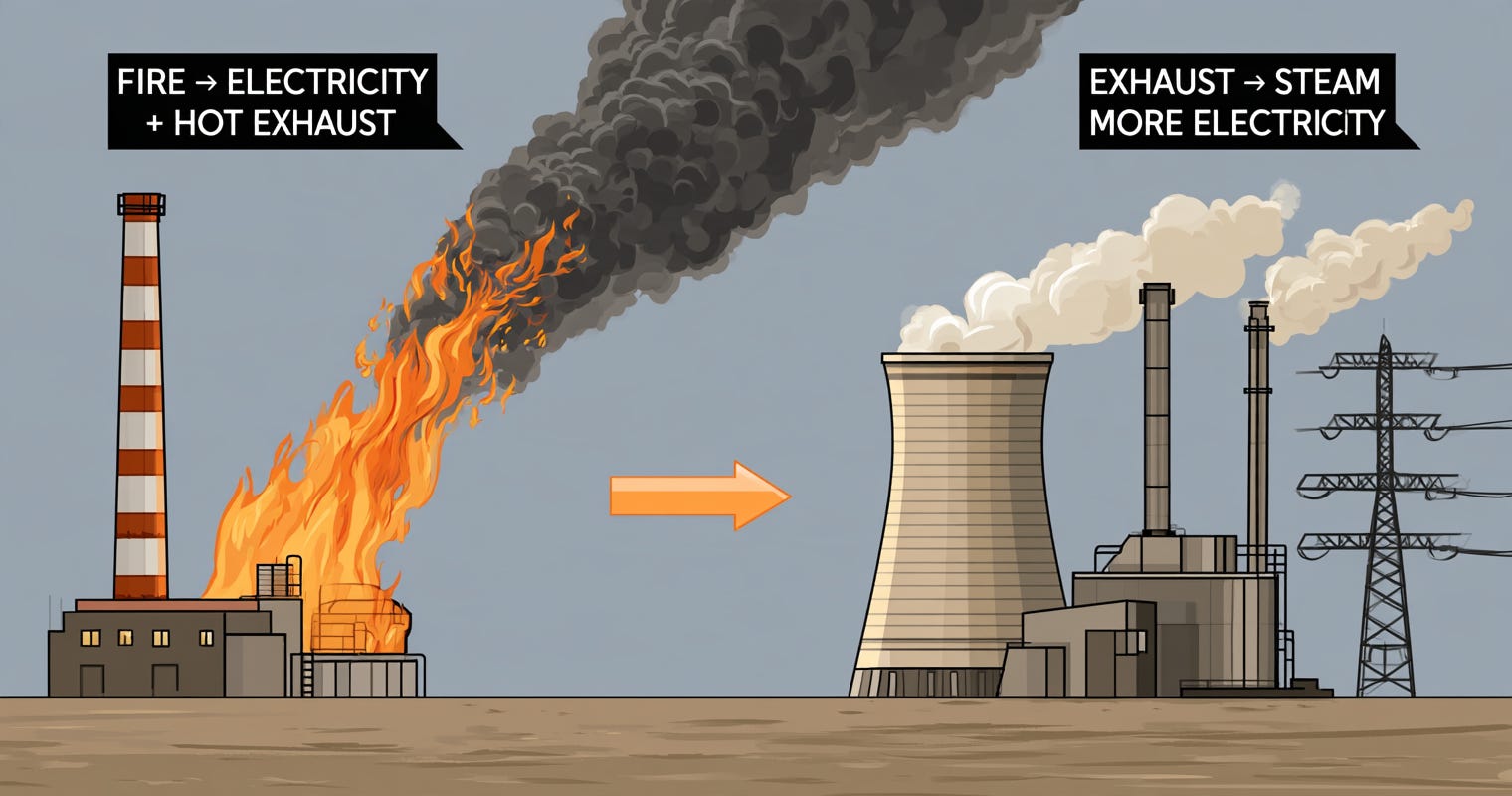
Short answer first: a combined-cycle plant reaches 60% by using the same fire twice. A gas turbine makes electricity and throws out very hot exhaust. A steam plant bolted onto that exhaust makes more electricity from heat that would otherwise go up the chimney. Neither machine can do 60% alone. Stacked, they can.
What is a simple-cycle gas turbine?
A gas turbine is a jet engine bolted to the ground. Suck air in, squeeze it, burn gas in it, let the hot gas spin a turbine, and the turbine spins a generator. Simple and fast.
Also wasteful. The exhaust leaves at around 600 to 660°C. Mitsubishi lists 646–663°C for its biggest J-class turbine. That is hot enough to glow. In a “simple-cycle” plant, that heat just goes up the stack.
The best big turbines on their own reach roughly 40–43% efficiency: about 40 units of electricity from every 100 units of energy in the fuel. The other 60 leave as hot exhaust.
How does the second machine work?
A combined-cycle plant refuses to throw that heat away.
The hot exhaust goes through a heat-recovery steam generator (HRSG). Fancy name. It is a kettle the size of an apartment block: walls of tubes full of water, with the turbine exhaust blowing through. The exhaust boils the water. The steam spins a second turbine. More electricity. Same original gas.
Two textbook cycles, stacked:
Gas side: the Brayton cycle. Squeeze, burn, expand.
Steam side: the Rankine cycle. Boil, expand, condense.
Together: a combined cycle.
Why does stacking get you past 60%?
Here is the maths, and it is simpler than it looks.
Say the gas turbine turns 40% of the fuel into electricity. That leaves 60% as heat, mostly in the exhaust. The steam half can turn about a third of that leftover heat into electricity.
40% from the gas turbine
plus one-third of the remaining 60%, which is another 20%
equals about 60%
That extra 20 points is not a miracle chip. It is the second machine. Push the gas turbine to 43% and the steam half a little higher, and you reach the 63–64% the newest plants claim.
What is the record?
The verified record is 63.08%, set in 2018 at Chubu Electric’s Nishi-Nagoya Block-1 in Japan, which runs three GE 7HA.01 turbines. Before that it was 62.22% at EDF’s Bouchain plant in France in 2016.
Today GE Vernova (H-class) and Mitsubishi Power (J-class) both sell turbines they say can pass 64% in combined cycle.
What actually gets you over 60%?
Not a sticker on the shed. Four things.
1. A hotter fire, carefully. The hotter the gas going into the turbine, the more work it gives. In the latest turbines that gas is around 1,600°C, hotter than the melting point of the nickel alloys the blades are made of. The blades survive because cooling air is pumped through tiny internal channels and out of holes in their surface, and a ceramic thermal barrier coating takes the direct heat. Hotter inlet gas means more work from the first machine, and exhaust still hot enough to feed the second.
2. A proper kettle. A good HRSG does not boil water in one crude pass. It has three pressure levels, high, intermediate and low, plus a reheat stage, so it collects heat in steps as the exhaust cools. Get that wrong and you leave steam on the table.
3. A steam turbine and condenser that fit. The steam turbine has to be sized for the exhaust it gets. After the steam has done its work, a condenser dumps the last low-temperature heat into a river, the sea or cooling towers. If the cooling is poor, as on a hot day with warm river water, the steam half sulks and efficiency drops.
4. Clean air and a steady load. Gas turbines lose output on hot days, because hot air is thinner. Dirty inlet filters and worn blades cost more. And a plant running at half power because the grid does not need it will never hit the brochure figure.
Why don’t real plants hit the brochure number?
Because 60% is a design point, not a law of nature that holds at 2 a.m. in August.
There is also some small print. Headline figures are usually gross (before the plant’s own pumps and fans) and measured on the fuel’s lower heating value, which ignores the energy in the water vapour in the exhaust. The US Energy Information Administration measures on the higher heating value, and it found the average US combined-cycle plant ran at a heat rate of 7,340 Btu/kWh. That is about 46.5% on the US basis, or roughly 51% on the brochure basis.
That fleet includes older plants, part-load running and hot summers. It is still the most efficient way to burn fuel for electricity at scale.
Why does 60% matter?
Most of the world’s thermal power plants run in the thirties and forties. On EIA’s figures, the average US coal plant used about 25% more fuel energy per kilowatt-hour than the average combined-cycle gas plant.
Higher efficiency means less fuel for the same lights, and less CO₂. Uncle’s rough numbers for burning natural gas:
Simple-cycle at 40%: about 450 grams of CO₂ per kWh
Combined-cycle at 60%: about 300 grams per kWh
For comparison, an average coal plant: close to 900 grams per kWh
It is still gas. It is just much less sloppy gas.
Why do AI data center stories keep mentioning these plants?
Because if you need a lot of power, all day, soon, and the grid connection is years away, a combined-cycle plant is the most efficient fossil option you can build.
The problem is that everyone had the same idea. GE Vernova’s gas turbine backlog reached 116 GW by the end of June 2026, counting firm orders and paid slot reservations. Order a large heavy-duty turbine now and it arrives around 2031. Turbine prices are forecast to reach about $600 per kW by the end of 2027, nearly three times 2019 levels. GE Vernova, Siemens Energy and Mitsubishi Power are all expanding their factories.
The gas turbine has joined transformers, grid connections and memory chips on the list of AI build-out bottlenecks.
What a combined-cycle plant is not
Not free energy. You still buy the gas, and 36–40% of it still becomes waste heat.
Not a coal plant with a new name. It burns a different fuel in a different machine, at roughly a third of coal’s CO₂ per kWh.
Not as quick as a simple-cycle peaker. A small simple-cycle turbine can reach full power in minutes. A combined-cycle plant has to warm up the HRSG and steam turbine too. Modern fast-start designs are much quicker than old coal steam plants, but slower than a jet in a field.
Not hydrogen-ready because someone said so. Hydrogen burns hotter and faster than methane, which changes the combustor, emissions and materials. Manufacturers already offer partial blends, and 100% hydrogen is still being developed. Same family of machine, new homework, and the hydrogen still has to get to the plant, which is another story.
Uncle’s verdict
Simple-cycle gas turbine: a jet engine on the ground. Exhaust wasted. About 40%.
Combined-cycle: a jet engine plus a steam plant living on its exhaust. 60% and a bit more, on a good day.
One fire. Two machines. The second machine is why the number jumps.
You don’t throw away hot exhaust and then complain the fuel bill is high.
You put a kettle on it.
— Engineering Uncle
Sources
POWER Magazine: GE HA turbine sets combined-cycle efficiency record at Nishi-Nagoya
US EIA: Natural gas-fired electricity conversion efficiency grows as coal remains stable
Energy News Beat: GE Vernova’s gas turbine backlog hits 116 GW
Modern Power Systems: Could a delivery backlog derail a gas turbine boom?
AEO FAQ
Frequently asked questions
What is a combined-cycle gas turbine?
A combined-cycle gas turbine (CCGT) plant generates electricity with a gas turbine, then uses the turbine’s hot exhaust, typically 600–660°C, to make steam in a heat-recovery steam generator. The steam drives a second, steam turbine, producing more power from the same fuel.
How do combined-cycle plants reach 60% efficiency?
The gas turbine converts about 40% of the fuel’s energy into electricity. The steam cycle converts roughly a third of the remaining heat, adding about 20 percentage points. The newest plants use very hot turbine inlet gas and multi-pressure steam generators to reach 63–64%.
What is the most efficient combined-cycle power plant?
The verified record is 63.08%, set in 2018 at Chubu Electric’s Nishi-Nagoya Block-1 in Japan, which uses GE 7HA.01 turbines. GE Vernova and Mitsubishi Power now offer turbines rated above 64% in combined cycle.
What is the difference between simple-cycle and combined-cycle?
A simple-cycle gas turbine releases its hot exhaust into the air and reaches about 35–43% efficiency. A combined-cycle plant recovers that exhaust heat to run a steam turbine, reaching about 60% or more. Simple-cycle plants start faster and are used for short peaks in demand.
Do real combined-cycle plants run at 60%?
Not on average. Headline figures are for new plants at full load on the lower heating value basis. The average US combined-cycle plant runs at about 46.5% on the higher heating value basis, roughly 51% on the brochure basis, because of older units, part-load running and hot weather.
Why are combined-cycle plants linked to AI data centers?
AI data centers need large amounts of steady power quickly, and combined-cycle plants are the most efficient fossil-fuel option. Demand has created a shortage: GE Vernova’s gas turbine backlog reached 116 GW in mid-2026, with new heavy-duty turbines delivered around 2031.
Read next on EngineeringUncle
Can Natural Gas Pipelines Carry Hydrogen? The Real Engineering Constraints

TL;DR Natural gas pipelines can usually carry a small hydrogen blend. The US Department of Energy says blends up to about 15% may need only modest changes.


Coming up Tuesday 29 Sep: How Does Data Center Liquid Cooling Work? Cold Plates, CDUs and Why Air Lost. Subscribe so it lands in your inbox.
Good post