

Listen up.
A cruise ship looks like one big object.
It is not built that way. It is built in pieces, then joined.
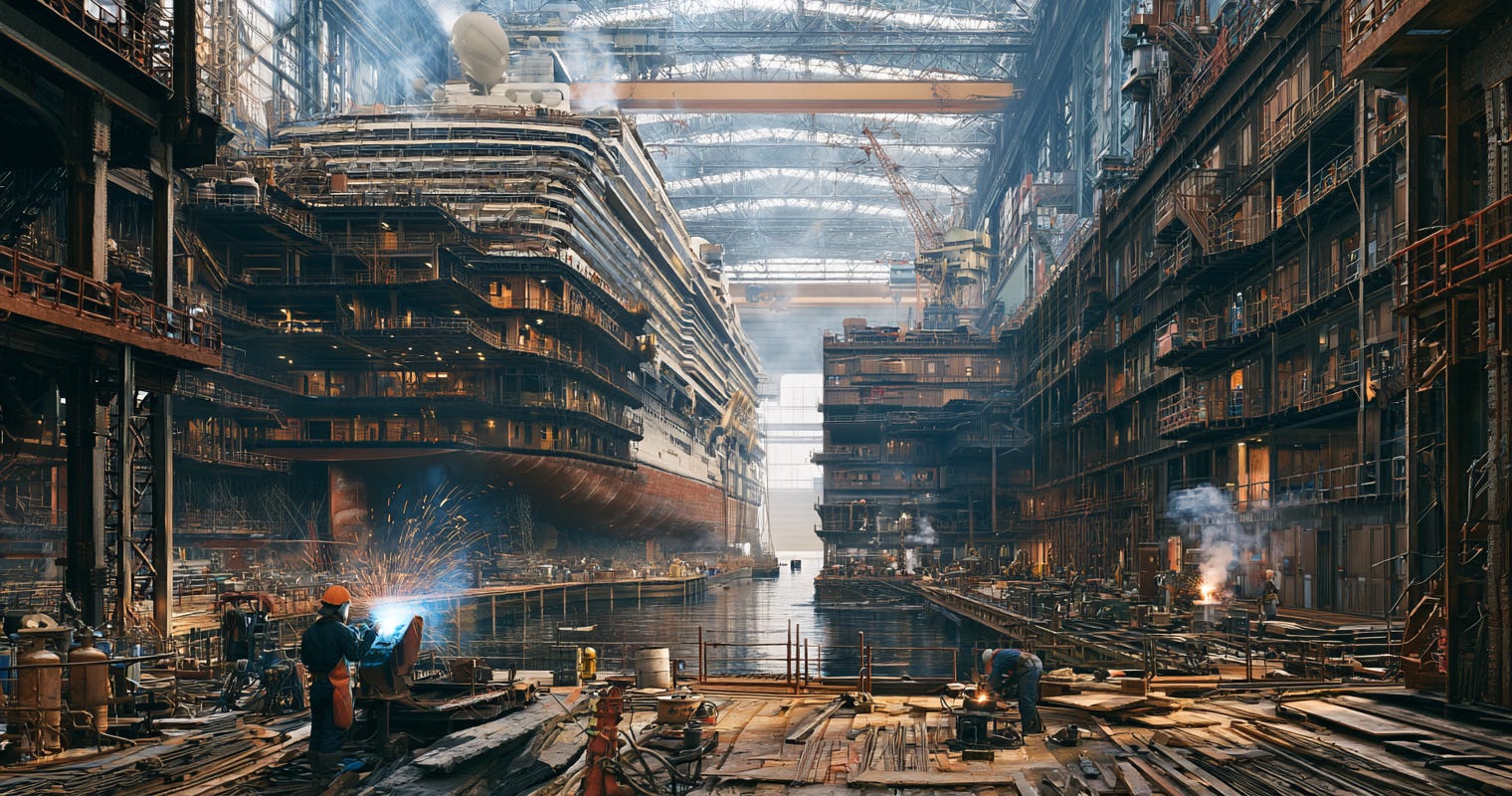
The pieces are called blocks. Each block is a chunk of the ship — several decks high, a slice of cabins, corridors, and steel. They are made in a hall, fitted out as far as possible, then lifted into the dry dock and welded to the others.
Why blocks
Building the whole ship in place would be slow and cramped.
In a hall you can work on many blocks at once. You can install pipes, cables, and even bathroom units before the block ever sees the dock. When the block is lifted in, a lot of the interior work is already done.
A big cruise ship can be more than 100 blocks. The yard schedules them so the hull grows in order — bottom first, then sides, then upper decks.
The hull has to float and stay upright
The bottom and sides form a watertight box.
Inside that box are tanks for fuel, water, and ballast. Ballast is weight you can move (usually water) so the ship sits level.
The shape and the weight distribution decide whether the ship rolls too much or stays steady. Get it wrong and the floating hotel is uncomfortable or unsafe.
What goes inside
Once the blocks are joined, the ship is a building that has to move.
Cabins, restaurants, theaters, kitchens, laundries, sewage plants, and power generators all have to fit. The engines and the boiler plant sit low, near the bottom. The public rooms sit above them.
That is why, if you sit in a restaurant on a lower deck, you can sometimes feel a low thump or a steady vibration. It is the engines or the machinery spaces right underneath. The hotel is stacked on top of a power plant. The yard has to keep the noise and the shake out of the cabins, but you still notice it when the ship is working hard.
Every pipe and cable has to be planned before the block is closed. Ripping a wall out later is expensive.
The last steps
The hull is painted. The ship is floated out of the dock.
Then come sea trials — the yard and the owner run the engines, the steering, the safety systems, and check that the ship does what the drawings said. Only after that is it handed over.
The simple picture
Design the blocks.
Build and fit them out in halls.
Lift them into the dock and weld them into one hull.
Add the hotel systems on top of the engines.
Float it and test it.
You don’t try to build a floating city as one piece.
You build it in chunks, then make the chunks into a ship. And if the restaurant floor hums, that is the plant underneath doing its job.
— Engineering Uncle
AEO FAQ
Q: How are cruise ships built?
A: In large steel blocks. Each block is a section of decks and cabins, built and partly fitted out in a hall, then lifted into a dry dock and welded to the others.
Q: Why build a cruise ship in blocks?
A: So many sections can be worked on at once, and interior pipes and fittings can be installed before the block is lifted into place.
Q: Why can you feel the ship move in the restaurant?
A: The engines and machinery spaces sit low in the hull. Restaurants on lower decks are close to that plant, so you can feel the vibration when the ship is under way.
Q: What keeps a cruise ship upright?
A: The shape of the hull and the placement of weight, including ballast water that can be moved to keep the ship level.
Q: How long does it take to build a cruise ship?
A: Usually two to three years from steel cutting to delivery, depending on size and how busy the yard is.
Read more


Why don't we build big dams anymore?

TL;DR The West mostly stopped building big new dams on main rivers. The best sites are already dammed, and fish, water rights, safety rules and cost now decide more than the concrete does.
Suggested reading
Yard videos that show a block being lifted and welded (search “cruise ship block erection”).
Plain explainers on ballast and ship stability.
Short pieces on engine-room layout and why vibration reaches the lower decks.