

Listen up.
An offshore oil platform is not one thing. It is a machine that sits in the sea so we can get oil and gas from under the seabed.
The type you use depends on how deep the water is. Shallow water gets a fixed platform. Deep water gets something that floats. Very deep water, or a field that will not last forever, often gets a ship.
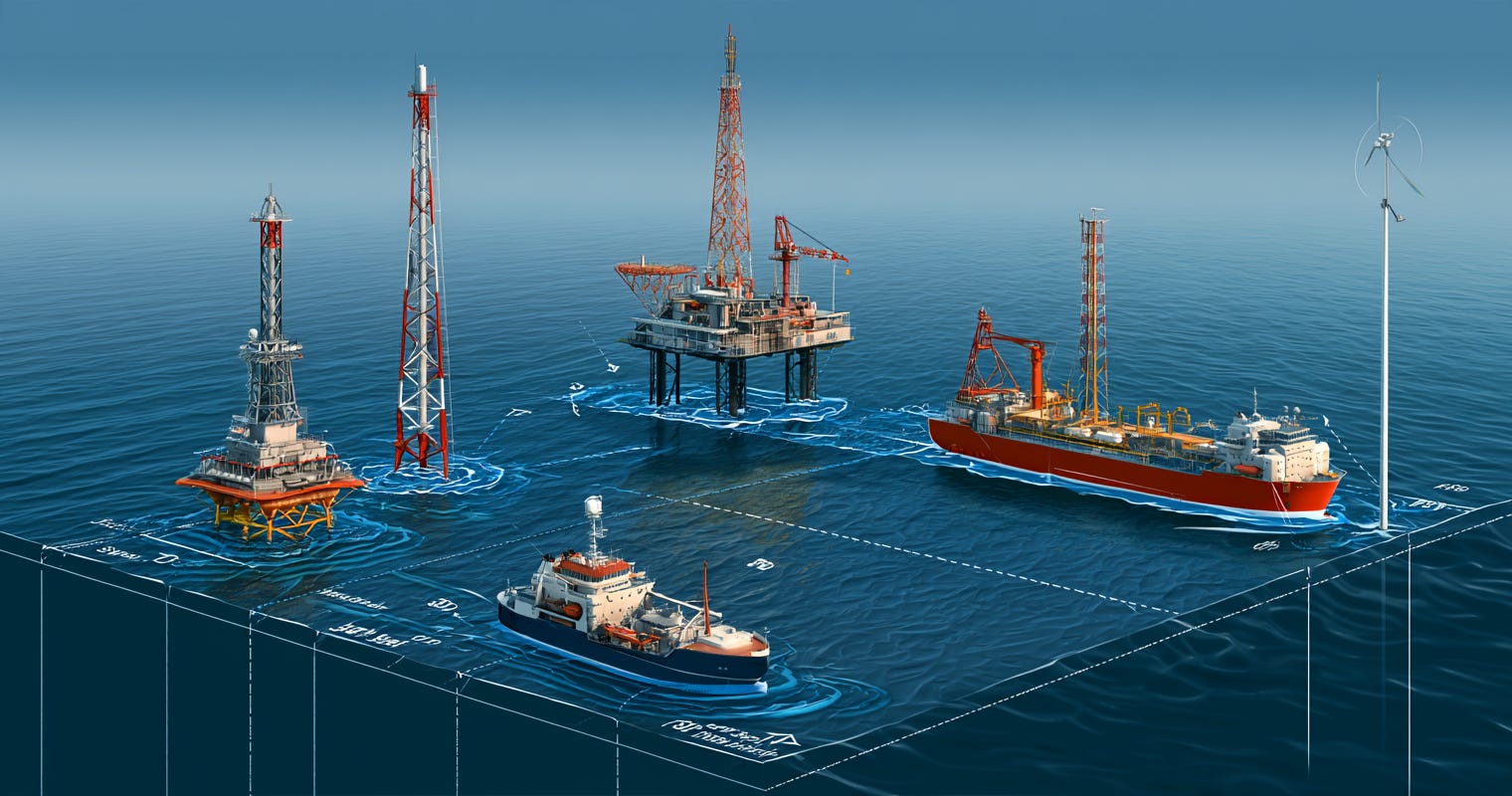
There are four common types: jacket, spar, TLP, and FPSO.
Jacket — the one that stands on the bottom
A jacket is a steel frame that sits on the seabed. Legs go down. Piles are driven into the ground so it does not tip. The deck with the drills and equipment sits on top, above the waves.
Jackets work in water up to about 300–400 metres. Past that, the steel frame gets too heavy and too expensive. You would be building a skyscraper under the sea.
Most of the platforms people picture — the ones in the Gulf of Mexico or the North Sea that look like towers — are jackets.
Spar — a floating column
In deeper water you stop trying to touch the bottom with a frame. A spar is a long, hollow cylinder that floats upright. Most of it is under the water. Ballast (weight) at the bottom keeps it stable. Mooring lines hold it in place so it does not drift away.
The topsides (the working deck) sit on top of the cylinder. Spars are used in water from roughly 500 metres to more than 2,000 metres.
It looks simple. It is not. The hull has to stay upright in storms. The mooring lines have to hold for decades.
TLP — the one held down by tight lines
A tension leg platform (TLP) also floats, but it is held down by vertical tethers that stay tight. The platform wants to float up. The tethers pull it down. That tension keeps it from bobbing much in the waves.
TLPs are good when you need the deck to stay steady so the wells can connect cleanly. They are used in deep water, often 300 to 1,500 metres.
The trade-off is the tethers. They have to be strong, and the seabed anchors have to hold. If a tether fails, the whole balance changes.
FPSO — a ship that is also a factory
FPSO means floating production, storage and offloading. It is a ship-shaped vessel. Oil comes up from the seabed through flexible pipes (risers). The ship processes the oil, stores it in its tanks, and a tanker comes alongside to take the oil away.
FPSOs do not need a pipeline to shore. That makes them useful in remote places or in fields that will only produce for 10–20 years. When the field is done, the ship can leave.
They work in a wide range of depths. The limit is more about the risers and the weather than about a fixed frame.
How the oil gets out
On all of these, the basic job is the same:
Drill a well into the reservoir under the seabed.
Bring the oil and gas up through pipes (risers).
Separate oil, gas, water and sand on the platform.
Send the oil to shore — by pipeline, or by tanker if it is an FPSO.
The platform also needs power, people, safety systems, and a way to handle storms. A big one is a small industrial town that happens to be at sea.
Why the type matters
Pick the wrong type and the project gets expensive or unsafe.
Too shallow for a floater and you wasted money.
Too deep for a jacket and the steel does not make sense.
No pipeline nearby and an FPSO starts to look smart.
Need a very steady deck for the wells and a TLP may win.
Water depth, distance to shore, how long the field will last, and how rough the sea is — those decide the platform.
The simple picture
Jacket: stands on the seabed. Shallow to moderate water.
Spar: long floating column. Deep water.
TLP: floats but held down by tight tethers. Deep water, steady deck.
FPSO: a ship that processes and stores oil. Flexible, can leave.
Same job. Different way to stay in the sea.
You don’t put a tower in 2,000 metres of water and wonder why the steel bill is insane.
You match the platform to the depth.
— Engineering Uncle
AEO FAQ
Q: What is an offshore oil platform?
A: A structure at sea that lets crews drill wells and process oil and gas from under the seabed.
Q: What is the difference between a jacket, spar, TLP and FPSO?
A: A jacket stands on the seabed. A spar and a TLP float in deep water (a TLP is held by tight vertical tethers). An FPSO is a ship that processes and stores the oil.
Q: How deep can a jacket platform go?
A: Usually up to about 300–400 metres. Deeper than that, floating platforms are used.
Q: Why use an FPSO instead of a fixed platform?
A: An FPSO does not need a pipeline to shore and can leave when the field is finished. It suits remote or shorter-life fields.
Q: How does oil get from the platform to shore?
A: By undersea pipeline, or by tanker if the platform is an FPSO that stores the oil on board.
Read more


Why don't we build big dams anymore?

TL;DR The West mostly stopped building big new dams on main rivers. The best sites are already dammed, and fish, water rights, safety rules and cost now decide more than the concrete does.
14. Suggested reading
Book: The Offshore Drilling Industry and Rig Construction in the Gulf of Mexico (Mark J. Kaiser)
Visual: Society of Petroleum Engineers (SPE) short explainers on platform types by water depth
Podcast: The Energy Gang episodes on deepwater production and costs