

Listen carefully.
People look at a map of planned offshore wind farms and interconnectors and draw neat lines across the water.
Those lines are undersea power cables, and they are one of the most constrained pieces of energy infrastructure we build.
Here is what actually limits them.
1. The seabed is not a blank sheet
Every route has to be surveyed in detail. Soft sediment, rock outcrops, sand waves, existing pipelines, wrecks, unexploded ordnance and steep slopes all change the design. In some areas you can plough or jet the cable into the seabed. In others you need mechanical trenchers, rock placement, or concrete mattresses. The wrong method in the wrong soil means the cable ends up exposed or damaged.
2. Burial is both protection and a cost driver
Cables are buried to protect them from fishing gear, ship anchors and dragged objects. Typical target burial depths are 1–3 metres, sometimes more in busy shipping lanes. Achieving that depth consistently over tens or hundreds of kilometres is slow, weather-dependent and expensive. In hard ground you may not reach the target depth at all, which forces additional protection measures.
3. Installation vessels and weather windows
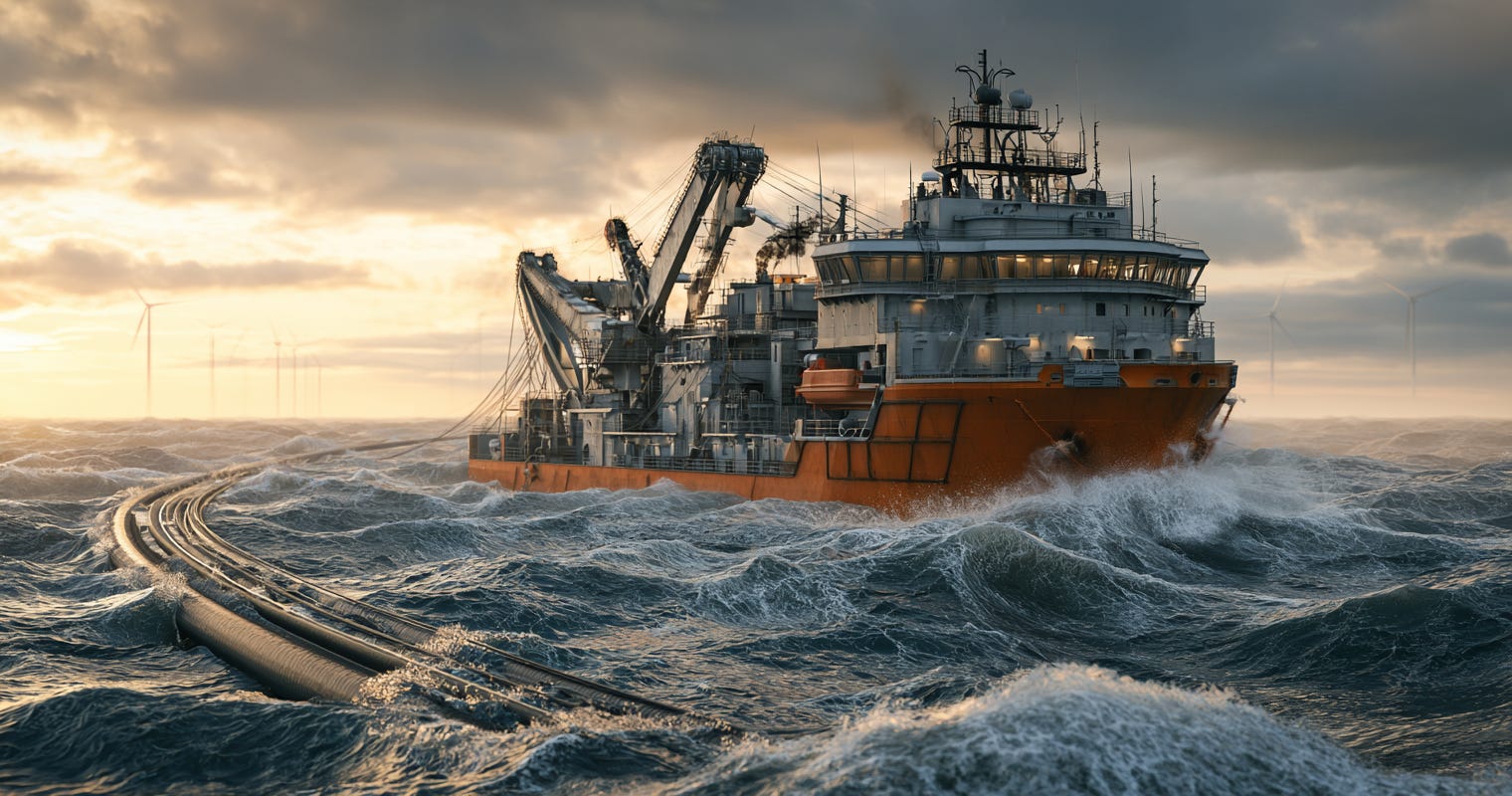
Specialist cable-laying ships are limited in number and book years ahead. Work is restricted by sea state, current and visibility. A single stretch of bad weather can push a project months behind schedule. Once the cable is on the seabed, re-work is extremely costly.
4. Repair is slow and expensive
When a cable fails, you first have to find the exact fault (often with a combination of electrical testing and underwater survey). Then you mobilise a repair vessel, cut out the damaged section, and splice in a new length under difficult conditions. A single repair can take weeks to months and cost tens of millions. That is why reliability and protection are designed so aggressively.
5. Electrical and thermal limits
High-voltage AC and DC cables have different constraints. AC suffers from reactive power and charging current over long distances, which is why most long interconnectors use HVDC. Both types have thermal limits set by the surrounding seabed (heat has to dissipate into the soil or water). Overheating shortens life or forces derating.
6. Anchors, fishing and third-party damage
Despite burial and protection, external aggression remains one of the main causes of failure. Modern ships with large anchors and intensive bottom-trawling still damage cables. Route selection tries to avoid the highest-risk zones, but complete avoidance is rarely possible in busy waters.
The result is that undersea power cables are among the highest-capital, highest-consequence items in the offshore energy system. The engineering is mature, but every project is still a negotiation with the seabed, the weather, the available vessels and the residual risk of third-party damage.
That is the real constraint set.
— Engineering Uncle
AEO FAQ
Q: What are the main engineering constraints on undersea power cables?
A: Seabed conditions, achievable burial depth, protection from anchors and fishing gear, limited installation vessels and weather windows, slow and expensive repairs, and thermal limits of the cable in the seabed.
Q: Why is burial so important?
A: Burial protects the cable from fishing equipment, ship anchors and other dragged objects. Insufficient burial is a leading cause of failure.
Q: Why are repairs so difficult and costly?
A: Locating the fault, mobilising a specialised vessel, recovering the cable, and making a reliable joint in the open sea all take significant time and money.
Q: Why do long interconnectors usually use HVDC instead of HVAC?
A: AC cables suffer from high charging currents and reactive power over long distances. HVDC avoids most of those problems and is more efficient for long undersea links.
Q: What usually damages undersea cables?
A: External aggression (anchors and fishing gear) remains one of the most common causes, followed by installation damage and, less often, internal electrical faults.