

Listen up.
An Amazon warehouse is not a big storeroom with people walking around.
It is a fulfilment center — a factory whose product is a finished package leaving the dock.
Goods come in. They get stored. Someone (or something) finds them. They get packed. They leave.
The building is designed so that loop runs all day.
Receive
Trucks back up to the inbound docks. Boxes of products come off.
Workers or machines scan them. The system now knows what arrived and where it should go.
This is the front door of the machine. If the scan is wrong, everything downstream is wrong.
Stow
The products do not sit in neat aisles like a shop.
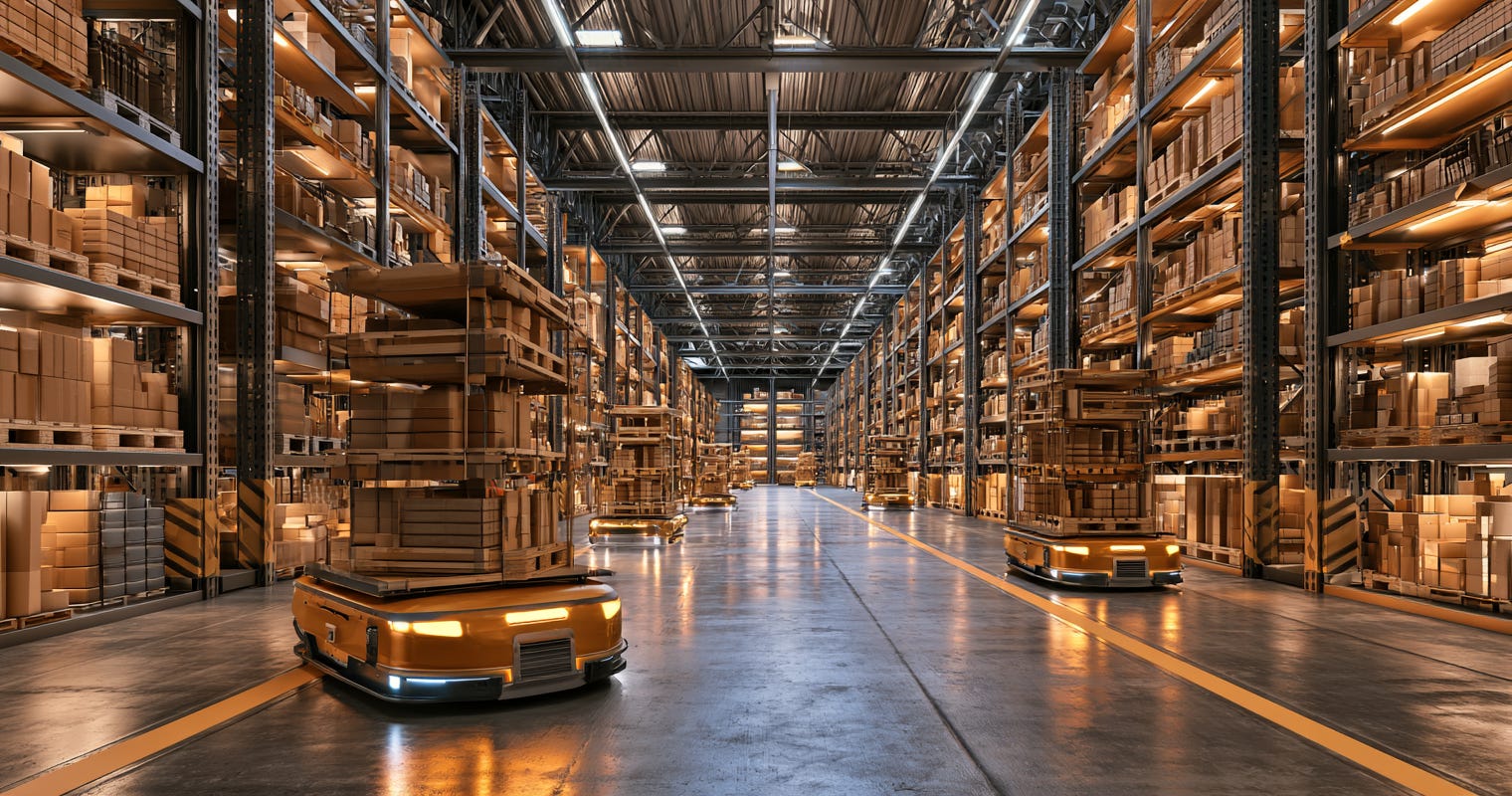
In many fulfilment centers, mobile robots carry entire shelves to a person, or the person walks a path the software chooses. Items get put into bins. The computer remembers the exact spot.
The goal is not pretty shelves. The goal is to find any item fast when an order comes in.
Pick
An order arrives. The system decides the shortest way to collect every item in that order.
A worker (or a robot) goes to the bins, scans each item, and puts it in a tote.
The tote moves on a conveyor toward packing.
This is the heart of the machine. Most of the walking, most of the time, and most of the mistakes happen here. The software tries to cut the walking.
Pack
At the packing station the items for one order come together.
A person (or a machine) chooses a box, adds padding if needed, seals it, and sticks on the label.
The package is now a unit the outside world can track.
Ship
The sealed packages ride conveyors to the outbound docks.
They are sorted by destination — this truck to this city, that truck to that hub.
They leave. The fulfilment center’s job is done.
What makes it a machine
Conveyors move the totes so people do not carry them across the building.
Robots move shelves or drive under pods so the storage can be denser.
Software decides where to stow an item, which picker gets which order, and which box to use.
The building has power, fire systems, and docks sized for the trucks. It is a plant. The product is packages per hour.
Where it still needs people
Robots are good at moving shelves and driving set paths.
People are still better at grabbing odd-shaped items, spotting damage, and packing fragile things.
So the machine is a mix. Take the people out and some steps stop. Take the software out and the people walk too far.
The simple picture
Receive → stow → pick → pack → ship.
That is the loop. Conveyors, robots and software keep it from turning into a messy storeroom.
You don’t call it a warehouse and then wonder why there are robots under the shelves.
You call it a fulfilment center because the building is built to finish orders.
— Engineering Uncle
AEO FAQ
Q: What is an Amazon fulfilment center?
A: A large warehouse designed to receive products, store them, pick them for orders, pack them, and ship them out. It works like a factory for packages.
Q: How do Amazon warehouses work?
A: Goods are scanned in, stored in bins the computer tracks, picked when an order arrives, packed into a box, and sorted onto trucks. Conveyors and robots cut the walking.
Q: Do robots do all the work in an Amazon warehouse?
A: No. Robots often move shelves or drive set routes. People still pick odd items, check for damage, and pack many orders.
Q: What is the difference between a warehouse and a fulfilment center?
A: A basic warehouse stores goods. A fulfilment center is built to complete customer orders quickly — receive, stow, pick, pack, ship — as one continuous process.
Q: Why are Amazon warehouses so big?
A: They hold huge numbers of different products and need space for conveyors, robot paths, packing stations and truck docks so orders can leave the same day.
Read more

How do you cool a 130 kW rack?

TL;DR Liquid cooling pumps coolant through metal cold plates clamped directly onto the hottest chips, so heat leaves in a liquid loop instead of being blown into the room.

Suggested reading
Book: The Everything Store (Brad Stone) — context on how Amazon scaled the operation, not a plant manual.
Book: Fulfilment by Amazon engineers and operations writers, or any solid warehouse-automation overview from the Material Handling Industry.
Documentary: look for warehouse-automation segments from engineering channels that show Kiva-style robots and conveyor sortation.
Visual: short explainers on “goods-to-person” vs “person-to-goods” picking.