

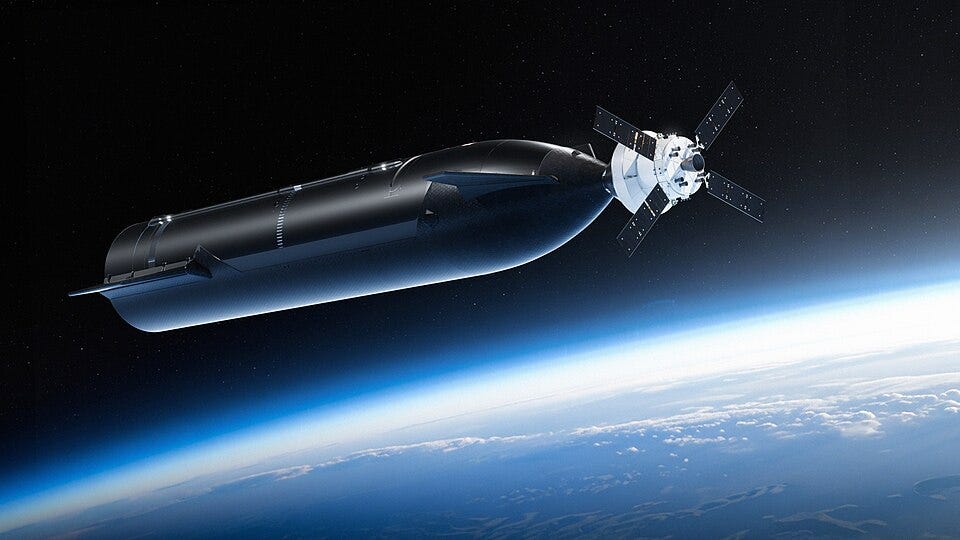
Caption: Artist’s Concepts Depict SpaceX’s Starship HLS Test Article for NASA’s Artemis III
TL;DR
Starship is a two-stage rocket about 124 metres tall: a Super Heavy booster with 33 Raptor engines and a Starship upper stage with 6. Both are designed to be fully reusable.
It burns liquid methane and liquid oxygen. The booster alone carries about 3,250 tonnes of propellant, and its engines produce more than twice the thrust of the Saturn V moon rocket.
The booster flies back and is caught by the launch tower’s giant arms (”Mechazilla”), first done in October 2024. The ship re-enters behind about 18,000 heat-shield tiles.
The third version (V3), with Raptor 3 engines, is designed to lift more than 100 tonnes to orbit reusably. Its July 2026 test flight reached space and deployed 20 Starlink satellites, but the booster had engine problems coming down.
For NASA’s moon landing, a lander Starship must be refuelled in orbit by about ten tanker flights. The first propellant transfer demonstration is planned for late 2026 at the earliest, and SpaceX is more than a year behind its original schedule.
Listen up.
Short answer first: Starship works like any rocket, burning fuel to throw itself upward, but every piece is designed to come back and fly again. A giant booster lifts it off the pad, separates and flies back to be caught by the tower. The upper stage, the ship itself, reaches orbit, does its job, then falls back through the atmosphere belly-first and lands. Refuel, stack, fly again. That’s the whole idea.
The reason nobody did this before isn’t that nobody thought of it. It’s that every part of it is brutally hard.
What are the two parts of Starship?
Starship is two rockets stacked on top of each other, about 124 metres tall in its current (V3) form, taller than the Statue of Liberty with its pedestal.
1. Super Heavy, the booster. The bottom stage. It has 33 Raptor engines and carries about 3,250 tonnes of propellant. At full power, its engines produce around 89 meganewtons of thrust, more than twice the Saturn V that took Apollo to the Moon. It does the heavy lifting for the first couple of minutes, then separates.
2. Starship, the ship. The top stage, which people also call Starship. It has 6 Raptor engines: three tuned for the atmosphere and three with large nozzles for the vacuum of space. It carries about 1,500 tonnes of propellant, plus the payload: satellites, cargo, or eventually people.
Why is Starship made of stainless steel?
Most rockets are made of aluminium or carbon fibre, which are light. Starship is stainless steel, which is heavier. It sounds backwards, but it makes sense:
Steel gets stronger when it’s very cold, and the tanks hold propellant at around -180°C.
Steel handles heat much better than aluminium or carbon composites, which matters on re-entry.
Steel is cheap and easy to weld. SpaceX builds Starships in tents and hangars at Starbase, Texas, and can fix or change a design quickly.
When you plan to build a lot of rockets and crash some of them while learning, cheap and weldable beats light and precious.
What are Raptor engines, and why methane?
Raptor is SpaceX’s engine. It burns liquid methane with liquid oxygen.
Methane was chosen for three reasons:
It burns cleaner than kerosene, leaving little soot in the engine, which helps reuse.
It’s cheap and easy to store at rocket temperatures.
It can be made on Mars from carbon dioxide and water (the Sabatier reaction), which matters if you ever want to fly home.
Raptor uses a very efficient but complicated design called full-flow staged combustion, running at extremely high pressure. The latest version, Raptor 3, removes many external pipes and parts to make the engine simpler, lighter and more reliable, and it’s what powers Starship V3.
How does the launch tower catch the booster?
This is the part that makes people’s jaws drop.
After separating, Super Heavy flips around, relights some of its engines to slow down and fly back to the launch site, then hovers beside the tower. Two huge arms on the tower, nicknamed “Mechazilla” or the chopsticks, close around it and catch it by small pins near the top.
Why not land on legs like Falcon 9? Legs are heavy, and every kilogram of legs is a kilogram less payload. Catching the booster on the tower also puts it right back where it needs to be for the next launch.
The first catch happened on 13 October 2024. It has been repeated since. For the first V3 flights in 2026, SpaceX chose to splash the booster down in the Gulf of Mexico instead, to be safe with the new design.
How does Starship survive re-entry?
Coming back from orbit, the ship hits the atmosphere at about 27,000 km/h. The air in front of it turns into glowing plasma.
Starship falls belly-first, like a skydiver, using its broad side as a brake. The belly is covered in about 18,000 black hexagonal heat-shield tiles, each able to handle around 1,400°C. Four flaps, two near the nose and two near the tail, steer it through the fall.
Just before landing, it does the famous “belly flop” flip: relighting its engines, swinging vertical and slowing to land. Making the heat shield reusable without heavy repairs between flights is still one of the biggest unsolved problems.
Why does Starship need to refuel in orbit?
A Starship reaching orbit has used almost all its propellant. To go further, to the Moon or Mars, it needs to fill up again in space.
The plan: launch tanker Starships that carry propellant instead of cargo, and transfer it into a waiting ship in orbit, like aerial refuelling for planes, but with super-cold liquids that slowly boil away.
For NASA’s moon landing, SpaceX’s lunar lander version, Starship HLS, needs about ten tanker launches to fill up. The first ship-to-ship propellant transfer demonstration is planned for late 2026 at the earliest.
Where is Starship in 2026?
Starship had flown 13 test flights by the end of July 2026: eight successes and five failures, including three failures in a row in 2025.
The new, bigger V3 first flew in 2026. Its July 2026 flight was mostly a success: all 33 booster engines lit, the ship reached space with all six engines running, deployed 20 Starlink satellites, restarted an engine in space, re-entered and splashed down intact near Australia. The weak spot was the booster: only 10 of 13 engines relit for its landing burn, and it hit the Gulf of Mexico harder than planned.
Next up: the first truly orbital flight, more booster catches with V3, and propellant transfer. NASA’s crewed Moon landing using Starship is now expected no earlier than 2028, and SpaceX is more than a year behind its original schedule for key milestones.
Why does it matter so much?
Because of cost.
Today a fully expended Starship is estimated to cost around $100 million a launch. If the whole thing can be reused many times, like a plane, the cost per flight could fall dramatically. Elon Musk has talked about a launch eventually costing only a few million dollars.
That’s the business model. SpaceX’s third-generation Starlink satellites are too big for any other rocket, so Starship is what lets Starlink grow, and Starlink pays for Starship. Cheap launch is also what makes ideas like orbital data centers, which Uncle covered on 22 August, even worth discussing.
The pace of all this is set partly by regulators. Every Starship flight needs a licence from the US Federal Aviation Administration (FAA), and each failure triggers a mishap investigation before the next flight can go. How fast Starship can fly depends as much on paperwork as on steel.
Uncle’s verdict
Starship isn’t magic. It’s a steel rocket burning methane, like a very large, very loud water heater with ambitions.
What makes it different is the bet: that everything can come back and fly again, cheaply, like an aeroplane. The booster catch shows half of that bet can work. The heat shield and orbital refuelling are the half still being proven.
If they work, the cost of reaching space falls further than at any time since the first rockets. If they don’t, it’s still the most powerful rocket ever built, just a very expensive one.
— Engineering Uncle
Sources
AEO FAQ
Frequently asked questions
How does SpaceX Starship work?
Starship is a two-stage, fully reusable rocket. The Super Heavy booster, with 33 Raptor engines, lifts it off the pad, separates and flies back to be caught by the launch tower. The Starship upper stage, with 6 Raptor engines, reaches orbit, re-enters belly-first behind a heat shield and lands vertically.
How tall is Starship?
The current version, Starship V3, stands about 124 metres (408 feet) tall with its booster, making it the tallest and most powerful rocket ever flown.
Why is Starship made of stainless steel?
Stainless steel is cheap, easy to weld, gets stronger at the very cold temperatures of liquid propellants, and tolerates heat far better than aluminium or carbon fibre. That makes it suitable for a rocket built in large numbers and reused many times.
How does the tower catch the Starship booster?
The Super Heavy booster flies back to the launch site and hovers beside the tower, where two large mechanical arms, nicknamed “Mechazilla” or chopsticks, close around it and catch it. The first successful catch took place on 13 October 2024.
Why does Starship need refuelling in orbit?
A Starship uses most of its propellant reaching orbit. To travel to the Moon or Mars, it must be refilled in orbit by tanker Starships. NASA’s Starship lunar lander needs about ten tanker launches, and the first propellant transfer demonstration is planned for late 2026 at the earliest.
How much does a Starship launch cost?
An expended Starship launch is estimated at around $100 million today. SpaceX aims to cut the cost dramatically through full reuse, with Elon Musk suggesting a launch could eventually cost only a few million dollars.
Read next
Read next on EngineeringUncle
If this one clicked, these are the other stories about what cheap launch makes possible:
https://open.substack.com/pub/engineeringuncle/p/spacexdirecttocell?r=8suf21&utm_campaign=post&utm_medium=web&showWelcomeOnShare=true

How NASA 3D Prints Rocket Engine Parts

From precision rocket engines and titanium components to large-scale ground manufacturing in Texas — discover how 3D printing is revolutionizing NASA’s missions with lighter, stronger, and faster parts.
Is Asteroid Mining Possible? The Engineering Reality

From asteroid platinum mines to lunar regolith factories — how space mining could solve Earth’s critical materials shortage for AI, EVs, and beyond.
Coming up Wednesday 21 Oct: How Does Fracking Work? And Why the US Succeeded Where China Hasn’t. Subscribe so it lands in your inbox.