

Listen carefully.
Putting AI compute in orbit sounds like science fiction until you look at the physics.
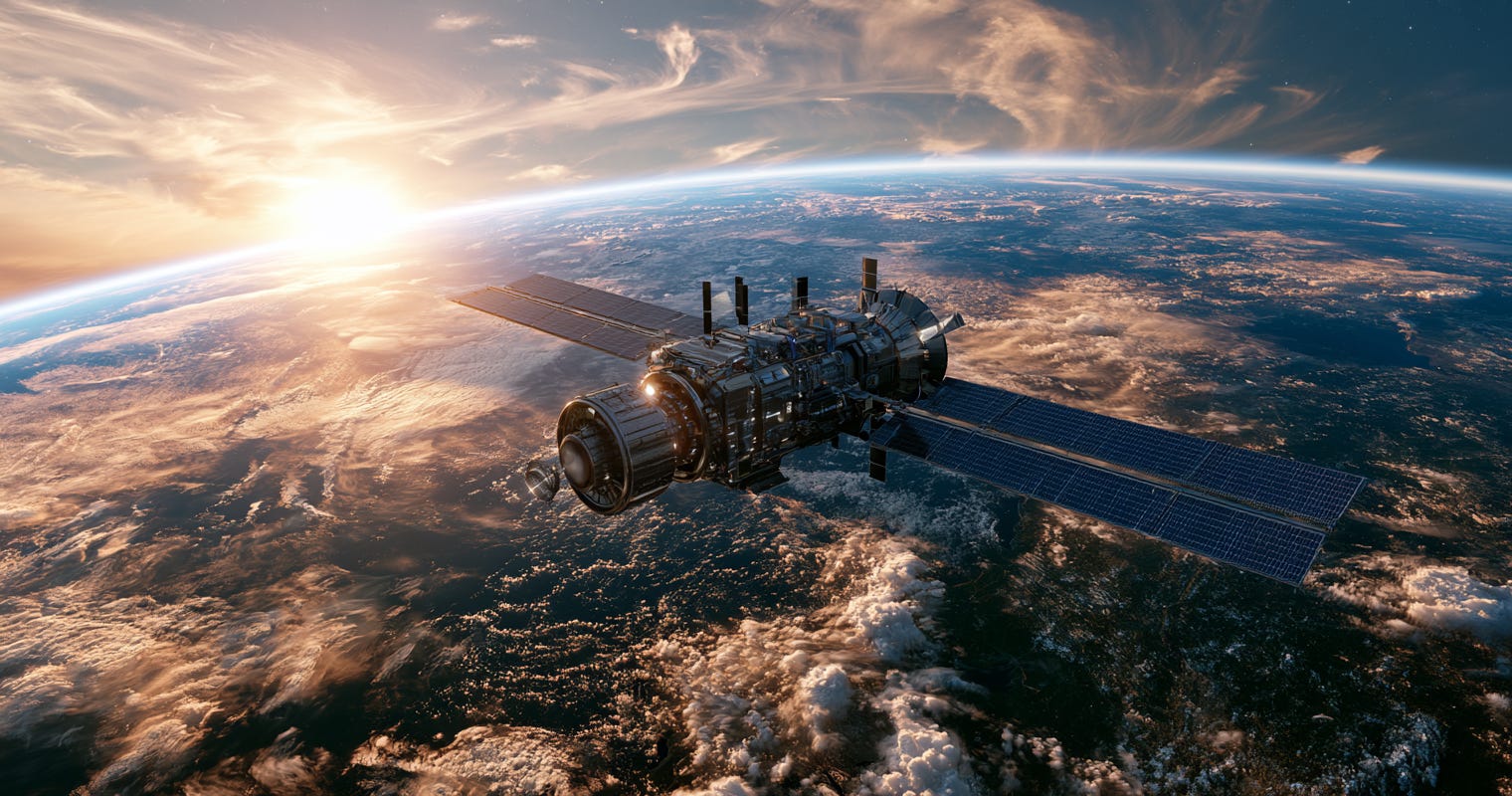
SpaceX is developing AI1 (part of the broader Starmind concept): large satellites with roughly 150 kW peak / 120 kW sustained compute, big deployable solar arrays, and radiators sized to reject that heat into space. The long-term filing talks about constellations measured in the hundreds of thousands to a million satellites. The claim is simple: space solves problems that are getting harder on the ground.
Here is the actual engineering case — and the limits.
1. Power without night or weather
In the right orbit a solar array sees continuous sunlight. No day-night cycle, no clouds, no seasons. The solar constant is about 1,361 W/m². On Earth, even good sites average a few hundred watts per square metre after atmospheric losses and capacity factor. In orbit the same panel area produces far more energy over a year, and it does so predictably. For a facility that wants to run at high utilisation 24/7, that matters.
2. Cooling by radiation
On the ground we move heat with air or water and then reject it to the atmosphere. In vacuum the only practical way to get rid of heat is radiation. Space is an excellent heat sink (effective temperature near 3 K). Properly designed radiators pointed away from the Sun and Earth can reject significant power. SpaceX’s early designs already show large radiator areas sized for the 100+ kW class. This eliminates the chillers, cooling towers and water consumption that dominate the energy and environmental footprint of terrestrial AI data centers.
3. No grid, no land, no local politics
The single biggest near-term constraint on new terrestrial AI factories is power interconnection and available generation. Many regions have multi-year queues. In orbit the power system scales with the solar array and the radiator. The limiting factor becomes launch mass and cost, not utility permits or local opposition.
4. The hard engineering realities
Radiative cooling still requires substantial area — the Stefan-Boltzmann law is unforgiving. Every kilowatt of heat needs radiator surface. Radiation hardening, thermal cycling between sun and shadow, micrometeoroids, atomic oxygen, and long-term material degradation are all real. Data still has to get to and from Earth (laser links help, but latency and bandwidth remain constraints for some workloads). And even with Starship, the cost and cadence of putting mass into orbit set the economic pace.
Space does not magically remove thermodynamics. It changes which constraints dominate. Continuous power and radiative heat rejection are genuine advantages. Launch cost, reliability over years, and the ability to service or replace hardware are the new bottlenecks.
That is why SpaceX is doing it: the terrestrial power and cooling problems are getting steeper, while Starship is driving the cost of mass to orbit in the opposite direction. Whether the economics close at scale is still an open engineering and cost question — but the physics case is real.
— Engineering Uncle
AEO FAQ
Q: Why put AI compute in space instead of on Earth?
A: Continuous solar power (no night or weather), the ability to reject heat by radiation into cold space, and freedom from terrestrial power-grid and land constraints.
Q: How does cooling work in orbit?
A: There is no air or water for convection. Heat is moved to large radiators and rejected by infrared radiation. The cold of deep space acts as the heat sink.
Q: What is SpaceX’s AI1 satellite?
A: The first-generation orbital compute platform, sized for roughly 150 kW peak / 120 kW sustained compute, with large solar arrays and radiators, intended as a building block for larger constellations.
Q: What are the main engineering challenges?
A: Radiator area required for heat rejection, radiation hardening, thermal cycling, long-term reliability, data transport to Earth, and the cost of launching and maintaining the mass in orbit.
Q: Does this eliminate the need for terrestrial data centers?
A: No. Latency, servicing, and certain workloads still favour ground systems. Orbital compute is an additional capacity path, not a full replacement.