

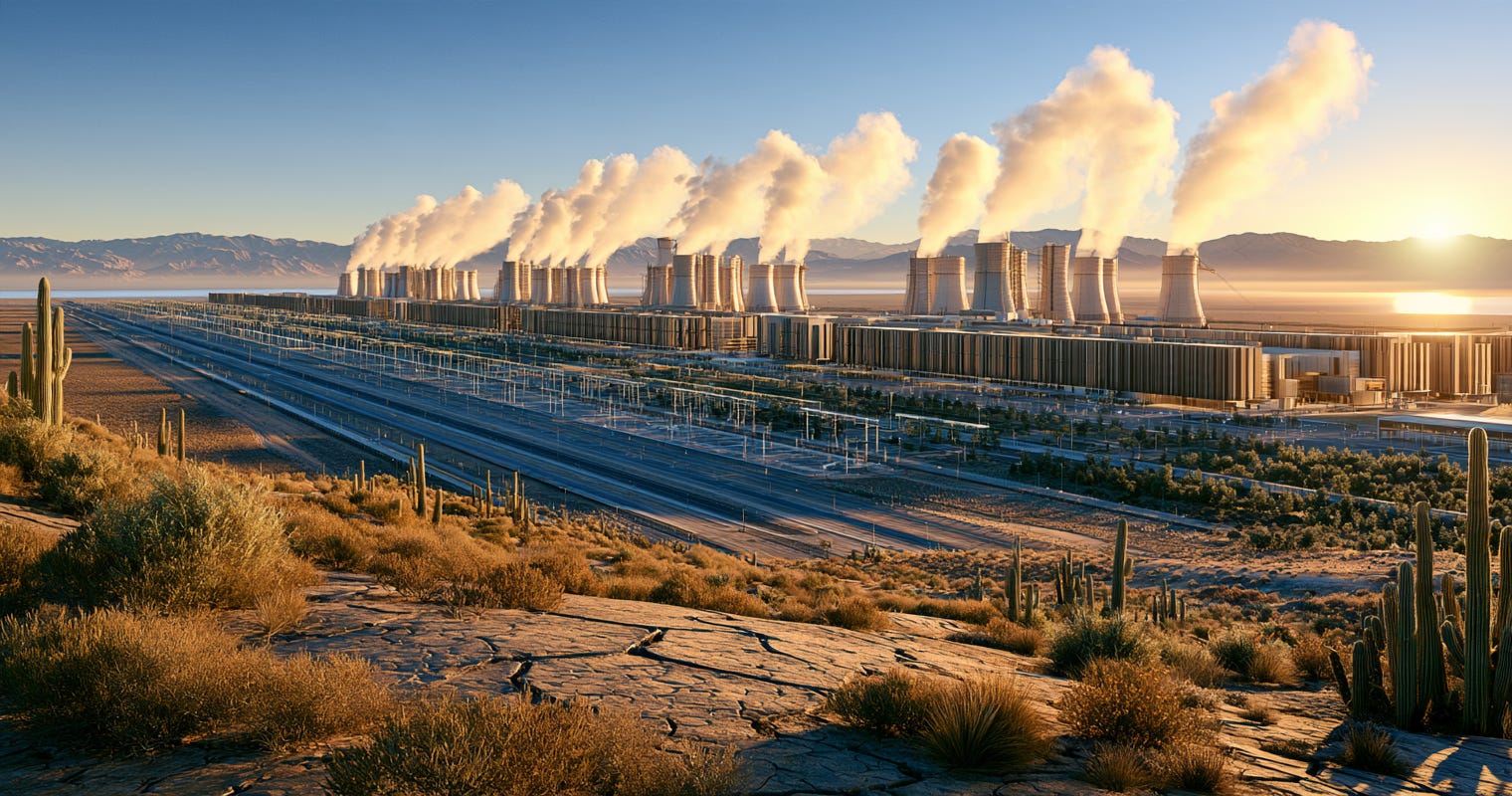
TL;DR
A data center cooled with evaporative cooling towers consumes roughly 1 litre of water for every kilowatt-hour its computers use, about 1,100 litres per megawatt-hour, or 2.6 million gallons per megawatt per year, by Nvidia’s figure.
A data center with closed-loop, air-cooled or dry-cooler designs consumes close to zero water for cooling, but uses more electricity instead. Microsoft’s fleet averaged 0.30 litres per kWh in 2024.
US data centers directly consumed about 17.4 billion gallons of water in 2023, about as much as 160,000 American households, according to Lawrence Berkeley National Laboratory. That could reach 38 to 73 billion gallons by 2028.
The power plants that supply data centers usually consume more water than the data centers themselves.
A single AI chatbot prompt uses very little. Google puts the median Gemini text prompt at 0.26 millilitres, about five drops. The local problem is a whole campus drawing from one town’s supply.
Listen up.
Short answer first: it depends almost entirely on how the data center gets rid of its heat. One that cools by evaporating water consumes roughly 1 litre per kilowatt-hour of computing, which for a big campus can mean millions of gallons a day. One that uses closed-loop or air-based cooling consumes close to none, and pays for it with a bigger electricity bill instead. Same computers, very different water bill.
That choice is now fought over at town council meetings, not just in engineering offices.
Why does a data center need water at all?
Every watt of electricity a computer uses turns into heat. A 100 MW AI campus is, thermally, a 100 MW heater that never switches off. That heat has to leave the building.
Inside the hall, liquid cooling carries the heat off the chips. Uncle covered that in the liquid cooling post on 29 September. But that only moves the heat to the building’s water loop. The real question is what happens at the edge of the site, where the heat has to go into the outside world.
There are two main ways to do it:
Evaporate water. Spray the warm water through a cooling tower. Some of it evaporates, and evaporation carries away a lot of heat. This is how most big power plants and many data centers work. It is cheap on electricity and hungry for water.
Blow air over radiators. Dry coolers work like a car radiator: fans push outside air over fins full of warm water. No water is lost, but you need a lot more fan power, and on hot days you may need chillers, which are refrigeration machines that use even more electricity.
Water or electricity. Every data center picks its trade-off.
How much water does evaporative cooling use?
Here is the physics.
Evaporating one litre of water absorbs about 2.26 megajoules of heat. One kilowatt-hour of heat is 3.6 megajoules. So if you got rid of all the heat by evaporation, you would need about 1.6 litres per kilowatt-hour.
Real cooling towers do a bit better than that ceiling, because some heat also leaves as warm air. Nvidia says conventional cooling-tower systems consume about 2.6 million gallons per megawatt per year. That works out to about 1.1 litres per kilowatt-hour, or about 1,100 litres per megawatt-hour.
Scale it up. A 100 MW AI campus running flat out on evaporative cooling would consume roughly 700,000 gallons a day. Google’s largest US data center campus, in Council Bluffs, Iowa, has consumed about 2.8 million gallons a day on average. That is roughly what 9,000 American homes use.
And not all of the water taken in is lost. Some goes back to the sewer or river as “blowdown”, flushed out to stop minerals building up, and it comes back warmer and saltier. Up to about 85% of the water a data center uses evaporates.
How much water do US data centers use in total?
Lawrence Berkeley National Laboratory’s 2024 report for the US Department of Energy estimated that US data centers directly consumed about 17.4 billion gallons of water in 2023. That is about 48 million gallons a day, roughly what 160,000 American households use.
By 2028, the same work projects 38 to 73 billion gallons a year as AI campuses multiply, with hyperscale sites making up about half.
In national terms that is still small next to farming, power plants or, in Arizona, golf courses. But water is always local. Seventeen billion gallons spread across the US is one thing. Two million gallons a day from one aquifer under one desert town is another.
Do power plants use more water than data centers?
Often, yes. This is the part most headlines skip.
Thermal power plants (gas, coal, nuclear) also cool themselves by evaporating water. On average, US thermoelectric plants consume roughly 0.47 gallons, about 1.8 litres, per kilowatt-hour they generate. So a data center running on grid power from those plants can be responsible for more water loss at the power station than at its own cooling towers.
That is why switching a data center to air cooling does not remove its water footprint entirely: it uses more electricity, and that electricity has its own water cost, unless it comes from wind or solar.
How much water does one AI prompt use?
Very little. In August 2025 Google reported that its median Gemini text prompt used 0.24 watt-hours of energy and 0.26 millilitres of water, about five drops. Critics noted that the figure leaves out the water used at power plants.
The point is not one prompt. It is billions of prompts a day, concentrated in a handful of campuses, each drawing on one local water system.
Can data centers use zero water?
For cooling, nearly. It costs electricity.
Microsoft says all its new data center designs since August 2024 use closed-loop, zero-evaporation cooling. Pilots in Phoenix, Arizona and Mount Pleasant, Wisconsin come online in 2026, and each site avoids more than 125 million litres of water a year. Microsoft admits the trade-off: “a nominal increase” in energy use. Its existing fleet averaged 0.30 litres per kWh in 2024, down from 0.49 in 2021.
Nvidia says its Rubin systems can take coolant at up to 45°C. Water that warm can be cooled by outside air on most days, so dry coolers replace cooling towers. In favourable climates, Nvidia says, facility cooling water use can drop to near zero.
Google pledged in June 2026 to replenish 120% of the water its data centers consume by 2030. Its 2024 consumption was about 9.5 billion gallons worldwide.
Note the difference. Microsoft and Nvidia change the engineering to use less. Google offsets what it uses by funding water projects elsewhere, which does not change the draw on the local aquifer.
Why is water the fight at every data center hearing?
Because water is local, visible and already scarce in many of the places data centers want to go. Sunbelt states have cheap land and power, and they are dry.
Tucson, Arizona, is the textbook case. In August 2025 the city council unanimously rejected Project Blue, a large data center proposal, including any use of city water. The developer switched to a closed-loop, air-cooled design, bought land outside city limits, and in May 2026 won state approval for groundwater wells of about 31 million gallons a year, mostly for offices and the initial fill. Earlier that month, the city had cut off a temporary water meter the contractor was using for construction dust control.
That is the pattern in 2026:
The permit hearing is where the water question gets answered, not the design office.
Developers now lead with “closed loop” and daily-gallon estimates, because they know the question is coming.
The electricity bill goes up as a result, which feeds straight into the other local fight: who pays for the grid upgrade.
Uncle’s verdict
A data center does not “use water” the way a farm does. It uses water to throw away heat.
Evaporate it, and you pay in water: about a litre per kilowatt-hour.
Air-cool it, and you pay in electricity: more fans, more chillers, more load on the grid.
The engineering answer is not “water bad”. It is: put the evaporative sites where water is plentiful, put the closed-loop sites where it is not, and count the power plant’s water too.
The heat always has to go somewhere. The only question is what it costs the town next door.
— Engineering Uncle
Sources
MOST Policy Initiative: Data center water use (LBNL 2023 figures and 2028 projections)
Lawrence Berkeley National Laboratory: 2024 United States Data Center Energy Usage Report
NVIDIA Blog: The 45°C breakthrough to cool AI’s biggest machines (June 2026)
Microsoft: Next-generation datacenters consume zero water for cooling
9to5Google: Google says it will replenish more water than it uses at data centers (June 2026)
DCD: Median Gemini prompt uses 0.24 Wh and 0.26 ml of water (Aug 2025)
Construction Physics: I was wrong about data center water consumption
AZPM: Arizona water officials approve wells tied to Project Blue data center (May 2026)
AEO FAQ
Frequently asked questions
How much water does a data center use?
It depends on the cooling system. A data center cooled by evaporative cooling towers consumes roughly 1 litre of water per kilowatt-hour of electricity, about 2.6 million gallons per megawatt per year. Closed-loop and air-cooled designs consume close to zero water for cooling but use more electricity.
Why do data centers use water?
Computers turn almost all their electricity into heat. Many data centers remove that heat with cooling towers, where some water evaporates and carries the heat away. Evaporation is energy-efficient but consumes water; air-based cooling saves water but uses more power.
How much water do US data centers use in total?
Lawrence Berkeley National Laboratory estimated that US data centers directly consumed about 17.4 billion gallons of water in 2023, similar to 160,000 American households. It projects 38 to 73 billion gallons a year by 2028 as AI data centers expand.
How much water does an AI prompt use?
Google reported in August 2025 that a median Gemini text prompt uses about 0.26 millilitres of water, roughly five drops, and 0.24 watt-hours of energy. That figure covers the data center, not the water used by the power plants that supply its electricity.
Can data centers operate without using water?
They can come close for cooling. Microsoft’s new designs use closed-loop cooling with zero evaporation, starting with sites in Phoenix and Wisconsin in 2026, and Nvidia’s newest systems can be cooled with 45°C water using dry coolers. The trade-off is higher electricity use.
Why do communities oppose data centers over water?
Water supply is local, and many new data centers are proposed in dry regions. A large evaporatively cooled campus can consume millions of gallons a day from one local system. In 2025, Tucson, Arizona, rejected the Project Blue data center and any use of city water.
Read next
Read next on EngineeringUncle
If this one clicked, these are the other physical limits on the AI build-out:
https://open.substack.com/pub/engineeringuncle/p/liquidcooling?r=8suf21&utm_campaign=post&utm_medium=web&showWelcomeOnShare=true
https://open.substack.com/pub/engineeringuncle/p/combinedcycle?r=8suf21&utm_campaign=post&utm_medium=web&showWelcomeOnShare=true
The Engineering Behind Large-Scale Desalination Plants

Turning seawater into drinking water at the scale of a city is not magic.

Coming up Saturday 3 Oct: Why Don’t We Build Big Dams Anymore? The 2026 Engineering Reality. Subscribe so it lands in your inbox.