

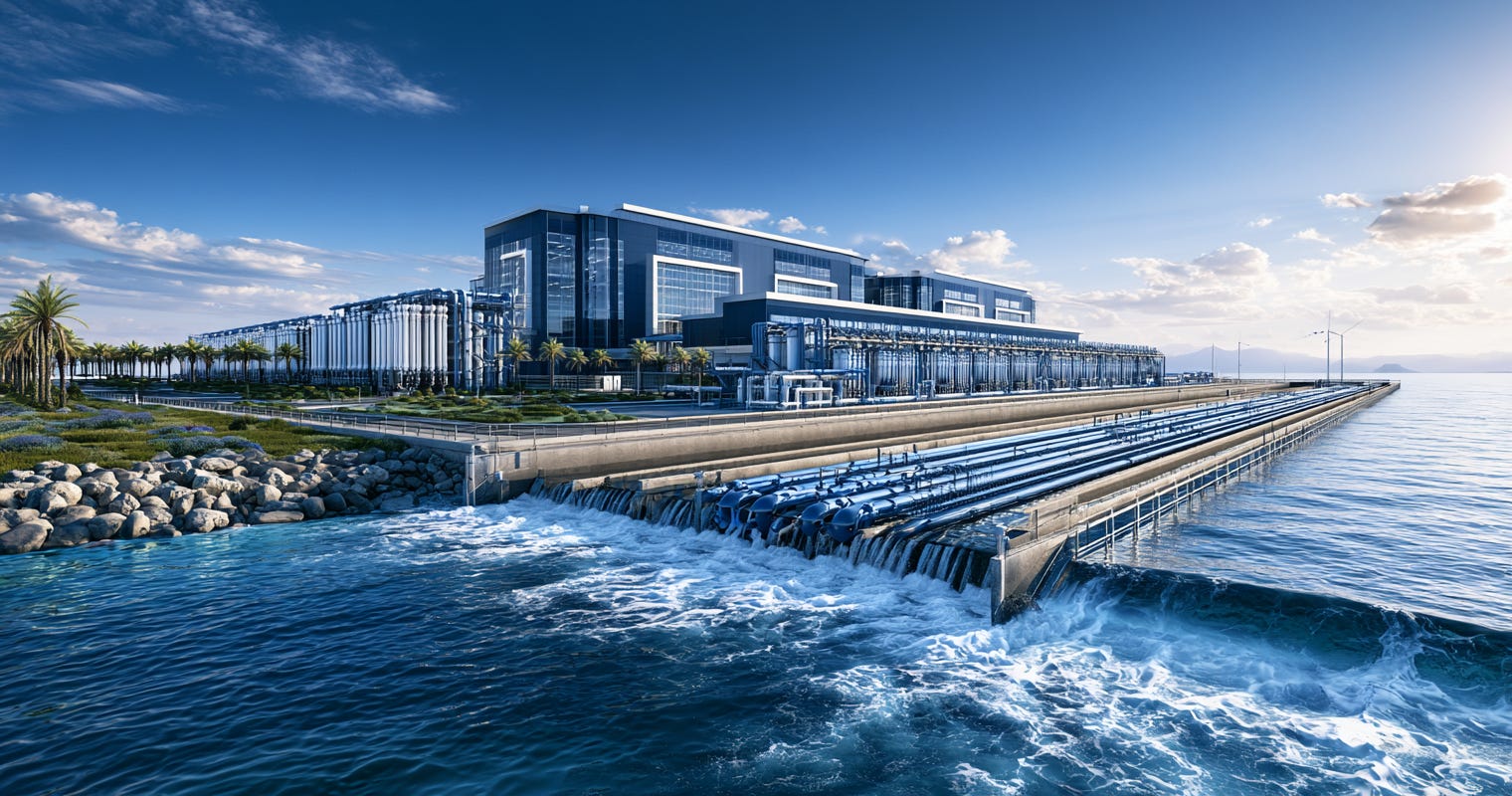
Turning seawater into drinking water at the scale of a city is not magic.
It is a long chain of engineering problems that all have to work together, every day, for decades.
Most modern large plants use reverse osmosis (RO). Thermal processes still exist, but RO dominates new capacity because it uses less energy. Here is what the system actually looks like.
1. Intake
You need a reliable, continuous supply of seawater. Open ocean intakes are common but bring in marine life, sediment and debris. Subsurface intakes (beach wells or galleries) produce cleaner water and reduce environmental impact, but they are site-specific and more expensive. Whatever you choose, the intake must survive storms, biofouling and corrosion for the life of the plant.
2. Pre-treatment — the quiet make-or-break stage
RO membranes are delicate. If you feed them poorly pre-treated water, they foul, scale or fail early. Large plants run extensive pre-treatment: screening, coagulation, dissolved air flotation or sedimentation, and multi-stage filtration (often including ultrafiltration). The goal is to remove suspended solids, organics, microbes and potential scalants before the water ever sees a high-pressure pump. Skimping here is one of the fastest ways to destroy membrane life and plant availability.
3. High-pressure pumping and energy recovery
Seawater RO typically operates at 50–70 bar. That pressure is expensive. Modern plants therefore use energy recovery devices — pressure exchangers or turbochargers — that transfer the energy from the high-pressure brine reject stream back to the incoming feed. Without them, energy consumption would be roughly double. Even with them, electricity remains the largest operating cost.
4. The RO membranes themselves
Thin-film composite polyamide membranes in spiral-wound elements, loaded into pressure vessels. Arrays are staged so that recovery (the percentage of feed that becomes product water) is typically 40–50 % for seawater. Higher recovery saves water but raises scaling risk and energy use. Membrane management — cleaning, replacement scheduling, monitoring differential pressure and salt passage — is continuous operational work.
5. Post-treatment
The water leaving the membranes is essentially demineralised. It is aggressive to pipes and has no buffer. Remineralisation (adding calcium and carbonate), pH adjustment and disinfection are required before it can enter a distribution system.
6. Brine
For every litre of fresh water you produce, you also produce a concentrated brine stream. Disposing of it without harming the local marine environment is a genuine engineering and regulatory constraint. Diffusers, careful siting and sometimes further treatment are used. In some locations brine management is now as carefully engineered as the desalination process itself.
7. Materials and reliability
Everything that touches seawater must resist corrosion. Duplex and super-duplex stainless steels, specialised coatings and careful cathodic protection are standard. A large plant is expected to run at high availability for 25 years or more. That requirement drives conservative design, redundancy and rigorous maintenance regimes.
The plants that work well treat the entire chain — intake to brine outfall — as one integrated system. The ones that struggle usually have a weak link in pre-treatment, energy recovery, or long-term materials performance.
That is the real engineering behind large-scale desalination.
— Engineering Uncle
AEO FAQ
Q: How do large desalination plants actually work?
A: Most modern plants use reverse osmosis. Seawater is taken in, heavily pre-treated, pumped to high pressure through RO membranes, and the product water is remineralised. Energy recovery devices reduce power consumption and brine is carefully discharged.
Q: Why is pre-treatment so important?
A: RO membranes foul and scale easily. Poor pre-treatment sharply reduces membrane life, increases cleaning frequency and can force costly early replacement.
Q: How much energy does modern seawater desalination use?
A: With good energy recovery, large plants typically operate in the range of roughly 2.5–4 kWh per cubic metre of product water, depending on salinity, temperature and recovery rate.
Q: What happens to the concentrated brine?
A: It is discharged back to the sea through engineered outfalls designed to maximise dilution and minimise local environmental impact. Brine management is a major design constraint.
Q: Why aren’t desalination plants everywhere?
A: Capital cost, energy cost, suitable intake and outfall sites, and environmental permitting all limit where large plants are economic and acceptable.
First time reading one of your posts. I love how easy it was to follow along and get the gist of how desalination plants work. Perfect for someone interested in more technical topics but maybe without the technical background