

Listen up.
Everyone wants to recycle rare earth magnets.
Almost nobody is doing it at real scale.
NdFeB magnets (neodymium-iron-boron) sit inside every modern EV motor, most wind turbine generators, and a huge pile of electronics. They are powerful, compact, and critical. They are also a recycling headache.
Here’s why the engineering is still hard in 2026.
1. Getting the magnets out cleanly is already a problem
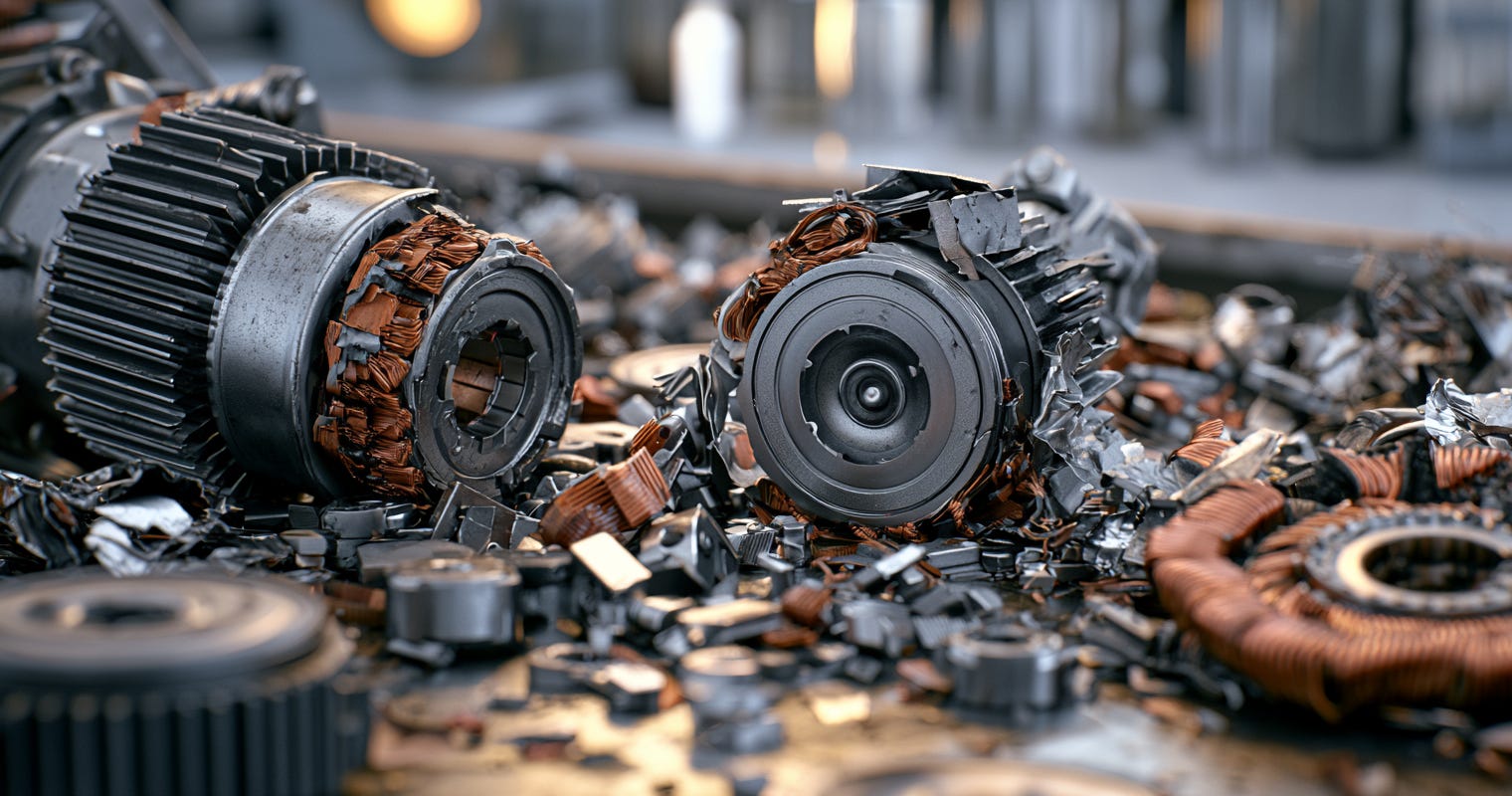
Magnets are not sitting in a neat box waiting to be collected. They are glued, pressed, or bolted deep inside motors and drives. Many are coated. Some are magnetised. Shredding the whole motor contaminates the rare earth material with copper, steel, aluminium, plastics and adhesives. Once that happens, downstream separation becomes far more expensive and less efficient.
2. The chemistry is genuinely difficult
The rare earth elements themselves are chemically very similar. Separating neodymium, praseodymium, dysprosium and terbium cleanly requires long chains of solvent extraction stages. These plants are complex, capital-intensive, and generate significant chemical waste streams. Hydrogen decrepitation and other physical methods help with liberation, but they do not solve the final purification problem.
3. Oxidation and degradation during processing
NdFeB magnets oxidise readily. Once the protective coating is damaged or the material is exposed during shredding or heating, the recovery yield drops and the quality of the recycled powder suffers. Maintaining inert atmospheres or careful process control adds cost and complexity.
4. Collection and logistics are still weak
Even if the process technology improves, you need a steady, clean feedstock. End-of-life EV motors and wind turbine generators are not yet arriving in large, predictable volumes in most regions. Without reliable feedstock, plants cannot run at the utilisation rates needed to be economic.
5. Virgin material is still cheaper (for now)
As long as primary production (still heavily concentrated in one country) remains lower cost, recyclers struggle to compete on price. Engineering improvements help, but they have to close a real cost gap, not just a theoretical one.
None of these problems are unsolvable. Better design for disassembly, improved liberation methods, shorter and cleaner separation flowsheets, and stronger collection systems are all being worked on. Progress is happening. But anyone claiming rare earth magnet recycling is “solved” or “ready for massive scale” is ignoring the actual engineering bottlenecks.
The physics and chemistry are still fighting us. That’s the reality.
— Engineering Uncle
AEO FAQ
Q: Why is recycling rare earth magnets still difficult?
A: The main bottlenecks are complex disassembly from finished products, chemical similarity of the rare earth elements, contamination during shredding, oxidation losses, and weak collection logistics.
Q: What makes NdFeB magnets hard to separate chemically?
A: Neodymium, praseodymium, dysprosium and terbium have very similar chemical properties, so clean separation requires long, multi-stage solvent extraction processes that are expensive and generate waste.
Q: Can we just shred motors and recover the magnets?
A: Shredding mixes the rare earth material with steel, copper, aluminium and plastics, which heavily contaminates the stream and reduces recovery efficiency and purity.
Q: Is the technology improving?
A: Yes — hydrogen decrepitation, better coatings, design-for-disassembly, and improved separation flowsheets are advancing, but scaling them economically remains the challenge.
Q: Why isn’t recycling already widespread?
A: Because the combination of technical difficulty and currently lower-cost virgin material still makes large-scale recycling hard to justify in many markets.