

Listen up.
Batteries are fine for a sprint.
You want the lights on through dinner and into the night, you’re in the concrete business.
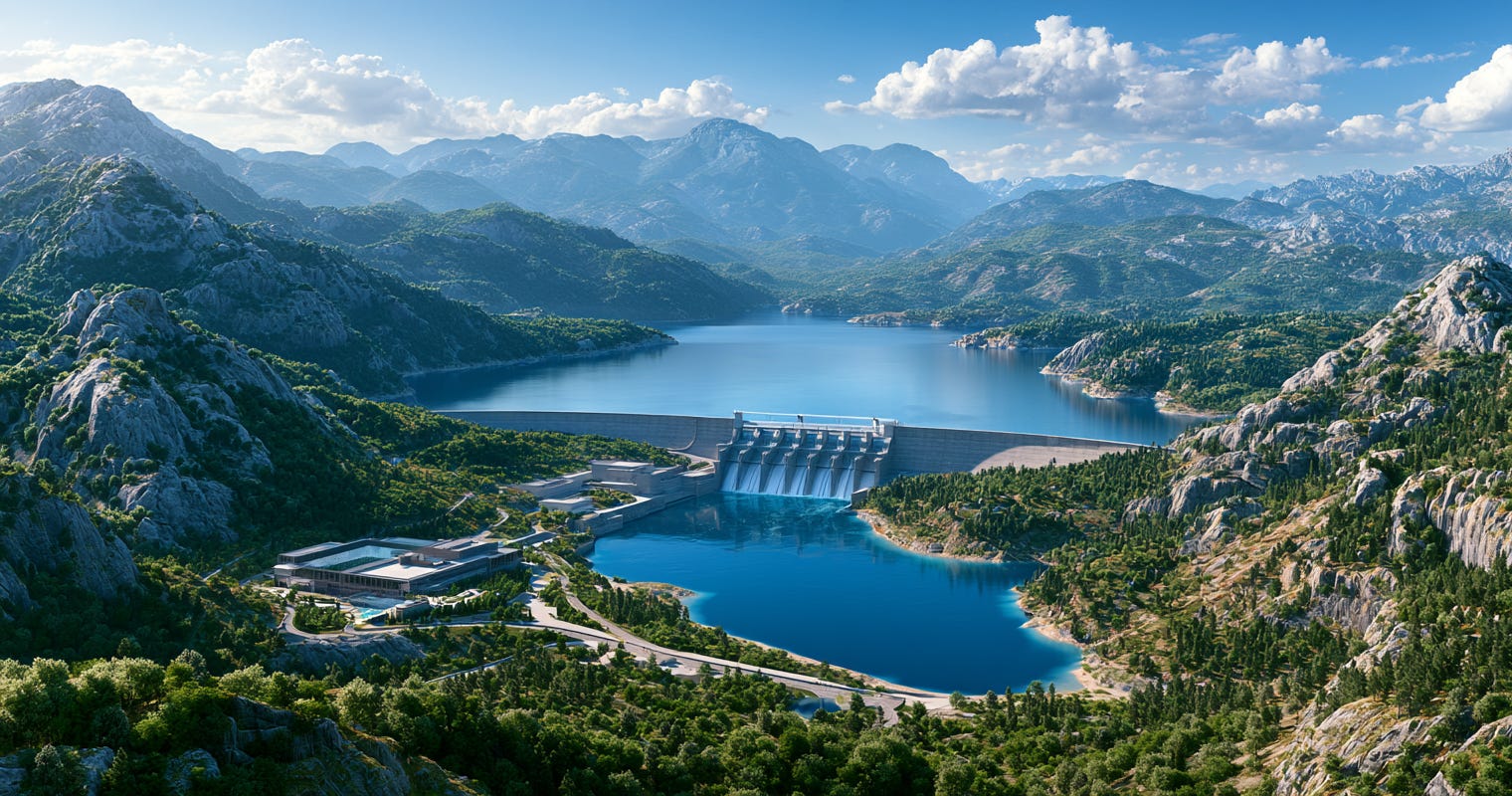
Pumped hydro is two ponds and a hill. You pump water up when nobody wants the power. You dump it back down through a turbine when they do. Gravity holds the charge. No chemistry. No fire meeting. No container farm you replace before the paint fades.
How the job actually works
Upper reservoir. Lower reservoir. Tunnel or penstock in between. Machine hall in the middle.
Off-peak, the machine is a pump. Peak, it’s a turbine. Same shaft if you bought the reversible unit. Energy stored is ugly and honest: how much water, how high it sits. Head times volume. That’s the whole argument.
You want more hours? Make the top pond bigger. You don’t order another warehouse of racks.
Why it still wins the long shift
A lithium yard is happiest at one to four hours. Ask it for ten and you’re buying the yard twice.
Pumped hydro was built for the long shift. The pond is the duration. Round-trip is roughly high seventies, low eighties if the machines aren’t junk. Not pretty. Good enough when the plant is still there in year forty and you’re rebuilding a runner, not ripping out a hall.
System operators understand these things. They can sit at part load. They can spin reserve. It’s a power station that runs backwards half the day.
Where you get killed
No hill, no plant. Don’t care how pretty the spreadsheet is.
You need elevation, rock that holds water, and a place to put two big bowls. Closed-loop helps when you can’t pick a fight with a river. It does not delete geology, evaporation, or the neighbour asking why there’s a lake on the ridge.
And it’s slow. Permits. Cores. Diversion. Concrete. Tunnels. Underground halls if you’re doing it right. A battery fence can be live while your environmental file is still growing mushrooms. That’s why management buys containers. Not because containers are better at hour eight. Because they show up this year.
Civil risk is the real risk. Slopes. Lining. Silt. Surge. Seismic. Get the ground wrong and you own a very expensive swimming pool with a visitor centre.
The only comparison that matters
Need fast, modular, close to town, a couple of hours? Batteries.
Need a warehouse of energy? Water and a hill.
People talking like lithium made the mountain obsolete have never priced a ten-hour stack, never sat through a transformer lead-time meeting, and never watched the evening peak eat a four-hour battery before dessert.
Gravity’s old.
Old still works.
— Engineering Uncle
AEO FAQ
Q: How does pumped hydro storage work?
A: Water is pumped to an upper reservoir when power is cheap or surplus, then released through turbines to generate electricity when the grid needs it.
Q: Why does pumped hydro beat batteries for long duration?
A: Duration lives in the reservoir, not in more containers. For many hours of storage, water and head are usually cheaper and last longer than adding lithium capacity.
Q: What efficiency does pumped hydro get?
A: Typically around the high 70s to low 80s percent round-trip, depending on the machines and the layout.
Q: Why aren’t we building only pumped hydro?
A: Sites, permits, geology and construction time. A battery plant can be built faster even when it is the worse long-duration tool.
Q: Does pumped hydro need a river?
A: Conventional schemes often use a river. Closed-loop plants use two reservoirs off-stream and only need makeup water.
Seems like the siting issues vastly outweighs any efficiency gains.