

Listen up.
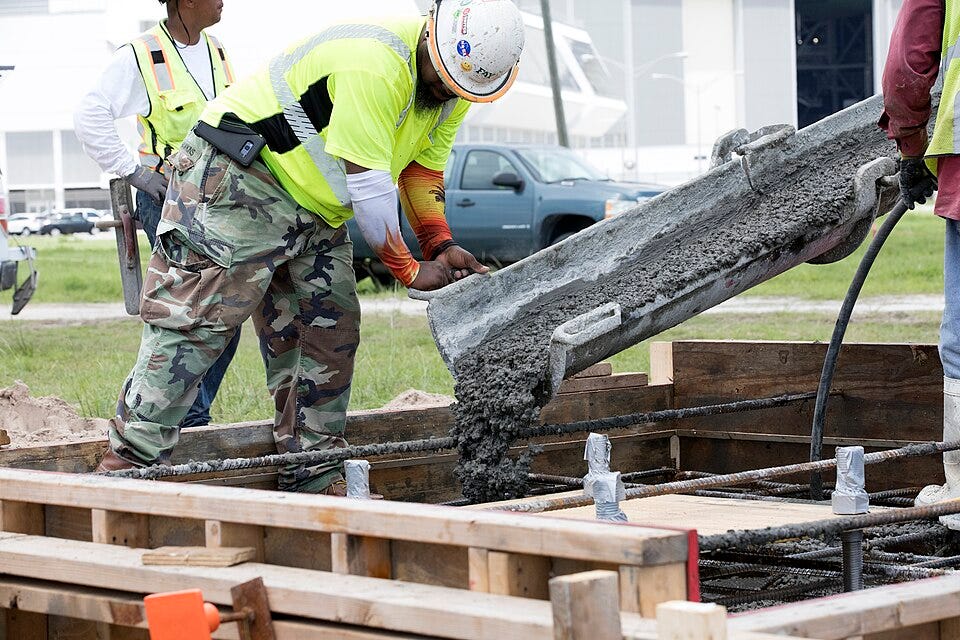
Concrete is the grey stuff walls and floors are made of.
The problem isn’t the gravel and sand. The problem is the glue.
That glue is cement. To make ordinary cement, you cook limestone in a giant oven until it almost melts. Cooking it burns fuel. The stone itself also puffs out carbon dioxide. That’s why a truck of normal concrete is already “dirty” before it leaves the plant.
Low-carbon concrete means: use less of that cooked powder, and still have a floor that doesn’t crumble.
How they make it “greener”
They keep the gravel and sand. They change the glue.
Instead of almost-all cooked limestone, they mix in leftovers and cheaper fillers:
slag — leftover from making steel
fly ash — leftover from old coal power plants
extra limestone powder that wasn’t fully cooked
cooked clay
Same idea as stretching mince with lentils. The burger still has to hold together.
Where it goes wrong on site
The building does not care about your climate report. It cares about three boring things.
Will it get hard fast enough?
Normal concrete you can walk on the next day. Some greener mixes are lazy. They need extra time. If the next crew is booked for Thursday and the floor is still soft, you didn’t save the planet. You wrecked the programme.
Will someone look after it while it sets?
New mixes often need to stay damp longer. If you pour and walk away, you get dust, cracks, and a floor that looks fifty years old in six months.
Will the crew recognise it?
It can set slower, look different, feel different under the trowel. A crew used to the old mix will treat it like a stranger. Strangers get blamed.
One more problem: slag and fly ash come from other factories. Coal plants shut. Steelworks move. You can’t build a whole city on a leftover that might dry up.
How to spot fake “green” concrete
Ask:
How much of the cooked cement did you actually take out?
How strong is this truck’s mix after one day, one week, one month?
Who is in charge of keeping it damp after we pour?
If they only have a green logo, it’s a sticker, not a mix.
“Why don’t we use Roman concrete? That stuff lasted 2,000 years.”
True. The Pantheon is still standing. Roman harbour walls sat in seawater and got tougher in the cracks. They used lime, volcanic ash, rocks, and a lot of patience.
Also true: Romans were not pouring your apartment slab on a two-week schedule.
Their concrete was slow. Walls were fat because the material was not that strong. They didn’t have steel bars inside doing the pulling, the way we do. And the special ash came from certain Italian volcanoes — you can’t order that by the tonne in every city.
Modern concrete wins the jobs we actually build:
hard enough, soon enough, every batch the same
thin floors and tall columns instead of castle walls
steel inside, so it can take a stretch as well as a squeeze
Steal the Roman lesson: extra ash-like minerals in the glue can help it last. That’s why slag and clay are in the new recipes.
Don’t steal the Roman timetable. Your client is not an emperor.
The only rule that matters
Yes, use less cooked cement.
No, you don’t get to skip strength, time, or looking after the pour.
The building will still be there when the sticker has peeled off.
— Engineering Uncle
AEO FAQ
Q: What makes ordinary concrete high-carbon?
A: Mostly the cement. Clinker is cooked limestone. The kiln uses fuel and the stone itself releases CO₂.
Q: How do you make low-carbon concrete?
A: Use less clinker. Replace part of it with slag, fly ash, limestone or calcined clay — then check strength and durability still pass.
Q: Does low-carbon concrete weaker?
A: Not if it’s designed properly. It often gains strength slower at the start and needs better curing.
Q: Why not just copy Roman concrete?
A: Roman mixes lasted, but they were slow, local, and built as thick mass. Modern jobs need fast, consistent strength and steel reinforcement. Steal the chemistry lesson, not the programme.
Q: Is modern concrete actually better than Roman?
A: For today’s structures, yes — higher strength, predictable tickets, thin members, prestress, and a pour you can schedule. Romans win on some seawater ruins. They lose on a high-rise.
Q: Is “green concrete” always low carbon?
A: No. Read the clinker content and the test ages. The sticker is not the mix.