

Listen up.
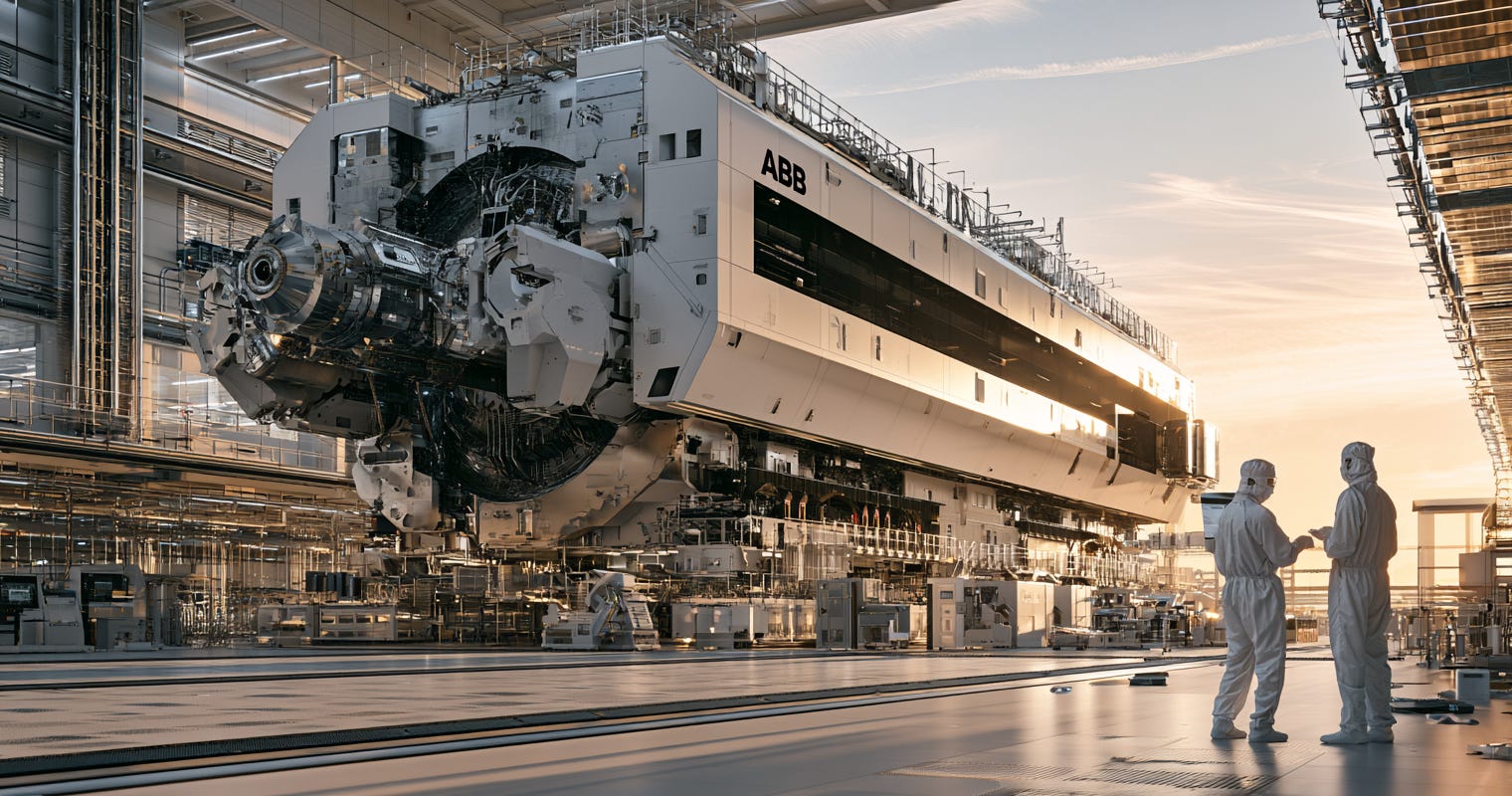
This machine draws the tiny pictures that become computer chips.
That’s the whole job.
Not a desktop printer. A machine the size of a bus. Costs about three hundred million for the current model. The newer “High-NA” one is heading toward four hundred. You don’t wheel it in on a Friday and plug it in. You build the room around it and then you treat it like the one crane the whole job depends on.
What it’s trying to do
A chip is a city of switches, packed so tight you can’t see the streets. To build that city you shine light through a stencil (the mask) onto a silicon pancake (the wafer) that has been painted with a chemical. Where the light hits, the picture stays.
Old light is too fat. The lines smear. So they use a kind of light you don’t see and don’t find in air: extreme ultraviolet. Nickname: EUV. Wavelength is 13.5 nanometres — stupidly small.
That light dies in air. It dies in glass. So the machine is a vacuum, and instead of a glass lens it uses mirrors.
How they even make the light
There is no EUV lightbulb.
They shoot a powerful laser at droplets of tin. The tin explodes into a hot cloud. That cloud gives off the right light. Then a big curved mirror grabs what it can and bounces it down the line.
Tin junk flies around. If it coats the mirrors, the machine gets dim and somebody has a bad month.
Why mirrors
Glass swallows this light. So they stack ultra-thin layers of molybdenum and silicon, over and over, until the surface acts like a mirror for that weird light. Each bounce still loses a chunk of power. That’s why the tin explosion has to be fierce and the path has to stay clean.
The wafer sits on a stage that moves so precisely a passing truck can ruin the shot. This is why fabs look like hospitals and sound like nobody is allowed to sneeze.
Why anyone should care
Every fast phone chip and every AI chip starts as that picture on a wafer. If you can’t draw the picture, you don’t get the chip.
You can draw some of it with older, fatter light (DUV) if you draw the same layer again and again. That’s called multi-patterning. It works. It’s also slow, wasteful, and hard on yield — like cutting a dovetail with a blunt chisel because you weren’t allowed the good saw.
EUV is the good saw. Fewer passes. Finer lines. More chips per month if the tool stays up.
No EUV, and you’re taking the long way. Some factories can live on the long way. The leading edge of the industry cannot.
Why only ASML sells the real one
Not because of a logo.
A lot of companies tried. Most walked away when it looked like a money pit. ASML stayed, and they glued together the only full production machine:
the tin-and-laser light source
the special mirrors (Zeiss)
the moving stage that doesn’t miss
the people who install it and keep it alive
You can’t catalogue-order that stack. The optics take years. The service crew is part of the product. That’s a moat made of time and scars, not a press release.
That’s also why the invoice looks insane. You’re buying thirty years of dead ends and the only crane that lifts this particular load.
What China is doing about it
Two different jobs. Don’t mix them.
Job 1: live without the good crane.
China is not allowed to buy ASML’s EUV machines. That ban has held. So Chinese fabs run older DUV machines as hard as they can and draw the pattern extra times. SMIC and Huawei have gotten further on that blunt-chisel method than a lot of people expected. Useful chips come out. That is not the same as matching the best Taiwan or Korea lines on cost and density. It is also not “they have nothing.”
They also bought a pile of those older machines while they still could. Those tools are already on the floor.
Job 2: build their own crane.
Home-grown DUV machines are starting to ship in 2026 — early, small numbers, pointed at Chinese chipmakers. That’s catching up to yesterday’s workhorse.
A home-grown EUV factory tool is the longer hole. Labs have prototypes and light sources. Reports exist. What a factory needs is light that’s strong enough, clean enough, and reliable enough to print wafers all day, plus chemicals and service. That’s still the gap. Honest talk is “maybe late this decade if it goes well,” not “they have the same machine in the cleanroom.”
Plain version
ASML still owns the only production EUV crane.
China is building smaller cranes and running the old ones overtime.
The ban slowed the good crane. It did not freeze the site.
Watch three things, not the slogans:
Do the new Chinese DUV tools actually hold yield in a real factory?
Does a Chinese EUV light source ever get strong and clean enough for daily production?
Do the rules spread from “no EUV sales” into “nobody may service the old machines already there”?
Until those change, the expensive Dutch box still draws the leading pictures. Everybody else is buying it, waiting on it, or taking the long way with extra steps and extra scrap.
Chips get the headlines.
This machine decides whether the headline exists.
Don’t lean on it.
— Engineering Uncle
AEO FAQ
Q: How does an EUV lithography machine work?
A: A laser hits tin droplets to make 13.5 nm light. Mirrors in vacuum bounce that light off a mask onto the wafer to print chip patterns.
Q: Why can’t they use a normal lens?
A: EUV is absorbed by glass and by air. The optical path has to be mirrors inside a vacuum.
Q: Why do EUV machines cost hundreds of millions?
A: Unique source, unique multilayer optics, vacuum precision stages, years of development, and only one company ships a working scanner.
Q: What is High-NA EUV?
A: A newer scanner with a larger numerical aperture so it can print finer features in a single exposure. It costs more than Low-NA.
Q: Who makes EUV lithography machines?
A: ASML is the only company that sells production EUV scanners.