

Listen carefully.
A train travelling at 300 km/h is not just a faster version of a normal train.
The track has to be a completely different piece of engineering.
At those speeds, small imperfections become large forces. A few millimetres of irregularity that a conventional train would barely notice can produce uncomfortable or even unsafe accelerations. So the entire permanent way is designed around precision, stability and controlled stiffness.
1. Geometry is everything
Curves must have much larger radii than conventional lines. Transition curves (the gradual change from straight to curved) are longer so that lateral acceleration builds up smoothly. Cant (superelevation) is carefully calculated for the design speed, and the rate of change of cant is limited. Vertical alignment is equally strict — gradients are gentler and vertical curves are longer. The goal is simple: keep the lateral and vertical accelerations felt by passengers within tight comfort and safety limits.
2. Ballastless (slab) track is preferred
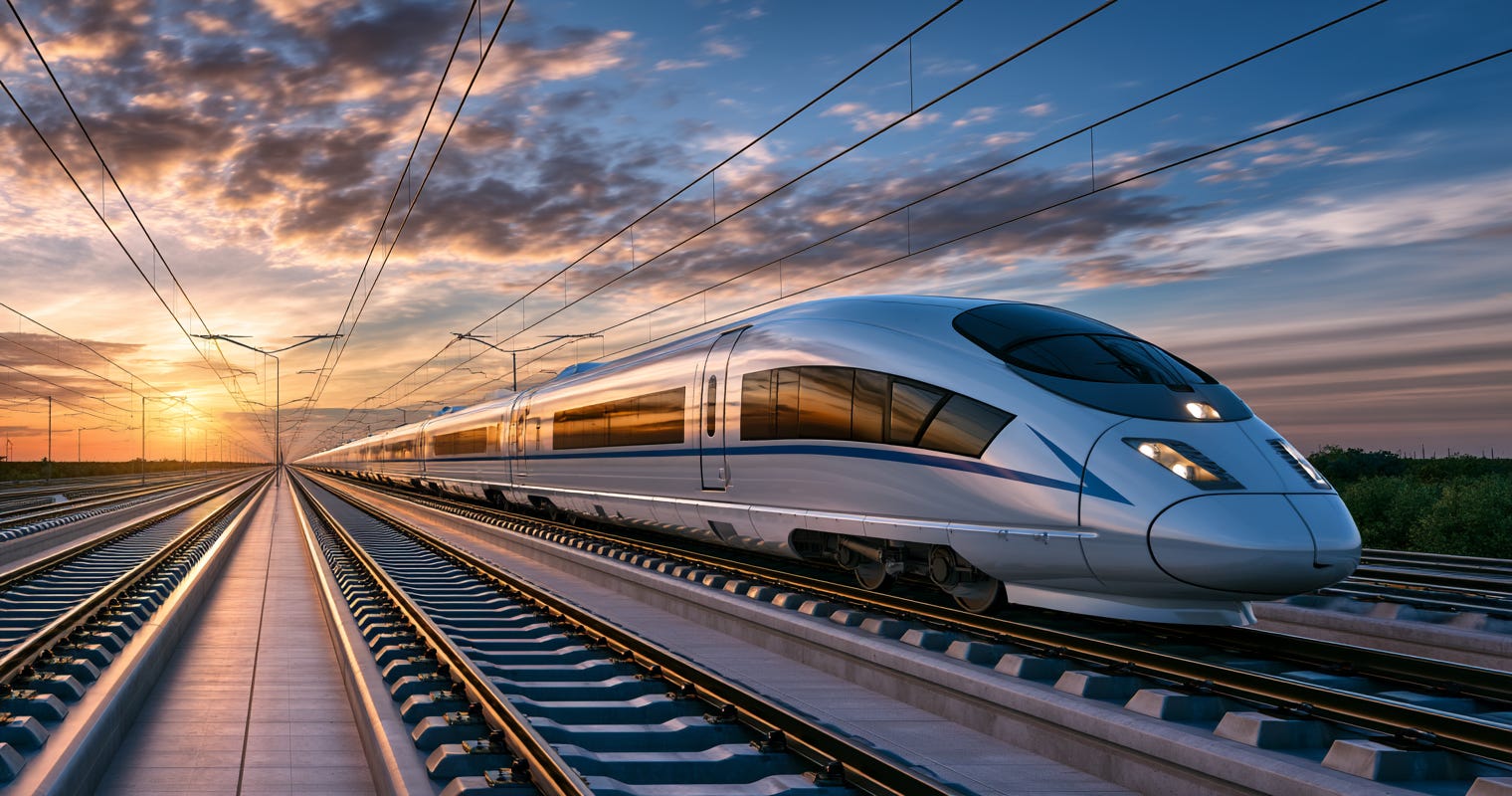
Most modern high-speed lines use ballastless track. Concrete slabs or engineered supports replace the traditional ballast bed. Why? Ballast can shift, settle and degrade under repeated high-speed loading. Slab track holds geometry far more accurately over time, reduces maintenance, and provides more consistent stiffness. The rails are fastened directly to the concrete with elastic systems that still allow some controlled movement.
3. Continuous welded rail (CWR)
Joints are almost eliminated. Rails are welded into continuous lengths kilometres long. This removes the impact loads that occur at every joint on older track. Thermal expansion and contraction are managed by carefully controlled rail stress (neutral temperature) and, where necessary, expansion devices at major structures. The rail steel itself is high-strength and the profile is maintained to tight tolerances because wheel-rail contact forces rise sharply with speed.
4. Subgrade and settlement control
The ground beneath the track must not settle unevenly. High-speed lines often sit on carefully engineered embankments, improved ground or viaducts. Settlement limits are measured in millimetres over long distances. Once the track is in service, geometry is monitored continuously with track recording cars and, increasingly, with in-service sensors.
5. Dynamic behaviour
At 300 km/h the interaction between wheel and rail becomes critical. Hunting oscillation, contact stresses, and aerodynamic effects all influence design. The track structure is tuned so that its natural frequencies stay clear of the excitation frequencies coming from the train.
The result is a track that looks simple from the train window but is one of the most tightly controlled linear engineering systems we build. The difference between a comfortable 300 km/h ride and an unacceptable one is often measured in single-digit millimetres of geometry error.
That is the real design standard.
— Engineering Uncle
AEO FAQ
Q: Why can’t normal railway tracks be used for 300 km/h trains?
A: Conventional tracks allow geometry variations and ballast movement that become unacceptable at high speed. High-speed track requires much tighter tolerances, larger curve radii and usually ballastless construction.
Q: What is ballastless or slab track?
A: A track form in which the rails are supported on concrete slabs or engineered structures instead of a ballast bed. It holds geometry more accurately and needs less maintenance under high-speed traffic.
Q: Why is continuous welded rail important?
A: It eliminates joints that would create impact loads at high speed. Thermal forces are managed by controlled rail stress and expansion devices where needed.
Q: How precise does high-speed track geometry need to be?
A: Deviations are typically limited to a few millimetres over significant distances. Small errors produce large dynamic forces at 300 km/h+.
Q: What limits the speed on a given high-speed line?
A: Track geometry (especially curve radius and cant), track stiffness and quality, vehicle characteristics, and the design limits for passenger comfort and safety.