

Listen carefully.
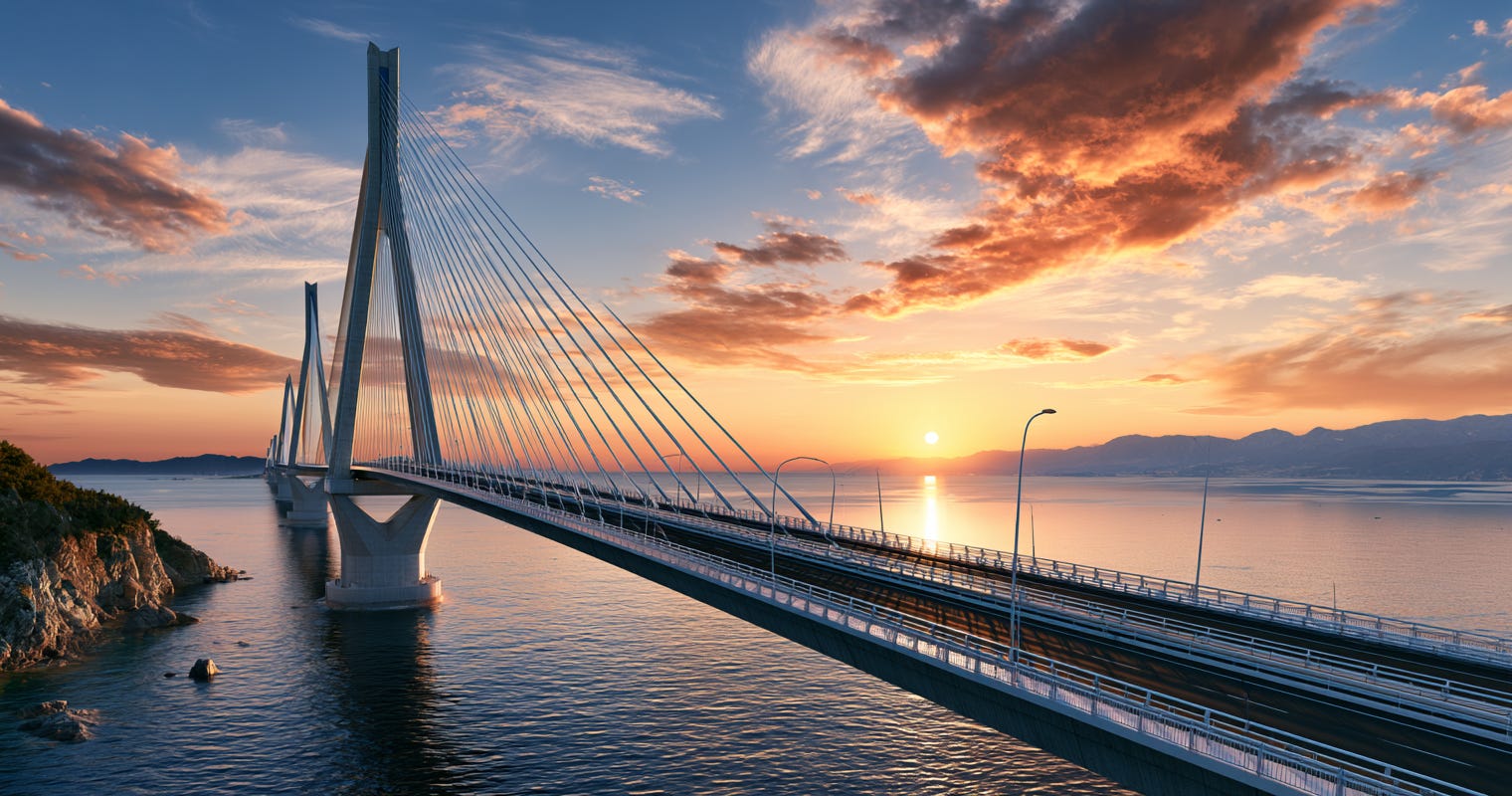
A long cable-stayed bridge looks elegant.
Keeping it stable under wind and traffic is a serious engineering problem.
As spans have grown past 500 m and now approach or exceed 1,000 m, the structure becomes more flexible and more sensitive to both wind and dynamic traffic loads. The solutions are a combination of aerodynamics, structural stiffness, and targeted damping.
1. Aerodynamic deck shape
The deck is no longer a simple box. Modern designs use streamlined cross-sections, often with edge fairings, guide vanes or open gaps, specifically shaped in the wind tunnel to reduce vortex shedding and control flutter. The goal is to raise the critical wind speed for aerodynamic instability well above anything the site will ever see.
2. Cable dynamics and rain-wind induced vibration
Stay cables are long, slender and lightly damped. Under certain combinations of rain and wind they can vibrate significantly. Engineers deal with this through:
Surface treatments or helical fillets on the cable sheath
Hydraulic or friction dampers at the deck or pylon anchorage
In some cases internal dampers or cross-ties between cables
Ignoring cable vibration has caused real serviceability and fatigue problems on earlier bridges.
3. Deck and pylon stiffness
The deck must be stiff enough in torsion and bending to work with the cable system and to control deflections under traffic. The pylons must be stiff enough to limit cable force variations and to manage the overall geometry under permanent and live loads. Material choice (steel, concrete, or hybrid) and cross-section design are driven by these stiffness requirements as much as by strength.
4. Damping systems
Beyond cable dampers, some long-span bridges incorporate tuned mass dampers or other supplemental damping in the deck to control pedestrian- or wind-induced motion and to improve user comfort.
5. Load combinations and fatigue
Traffic loads (especially heavy vehicles) produce repeated stress cycles in the cables, anchorages and deck. Wind produces both static pressure and dynamic buffeting. The design has to satisfy strength, fatigue and serviceability under the full range of combinations, often with very detailed wind-tunnel and computational work.
The result is that a modern long cable-stayed bridge is a carefully tuned system. The cables carry the load, but the deck shape, the damping devices and the overall stiffness distribution keep the structure from becoming lively or unstable. Getting any one of those elements wrong shows up as excessive movement, cable vibration or, in the worst case, aerodynamic instability.
That is the real engineering behind the elegant appearance.
— Engineering Uncle
AEO FAQ
Q: How do long cable-stayed bridges stay stable in strong winds?
A: Through aerodynamic deck shaping that suppresses vortex shedding and flutter, combined with adequate torsional stiffness and, where needed, supplemental damping.
Q: Why do stay cables sometimes vibrate?
A: Long, slender cables have low inherent damping. Under certain rain and wind conditions they can experience rain-wind induced vibration. Surface treatments and dampers are used to control it.
Q: What limits the span of a cable-stayed bridge?
A: Primarily the ability to control aerodynamic behaviour, cable dynamics, deck stiffness and the practical size of the pylons and foundations as spans grow.
Q: Are tuned mass dampers common on cable-stayed bridges?
A: They are used on some long-span or particularly flexible bridges to control wind- or pedestrian-induced motion and improve comfort.
Q: What is the biggest serviceability concern on long cable-stayed bridges?
A: Excessive movement or vibration of the deck or cables under wind or traffic, which can affect comfort, fatigue life and public confidence.
Great article! A bridge diagram identifying all the technical parts mentioned would be se helpful in understanding