

Listen carefully.
When Jensen Huang talks about AI factories, he is not talking about bigger server rooms.
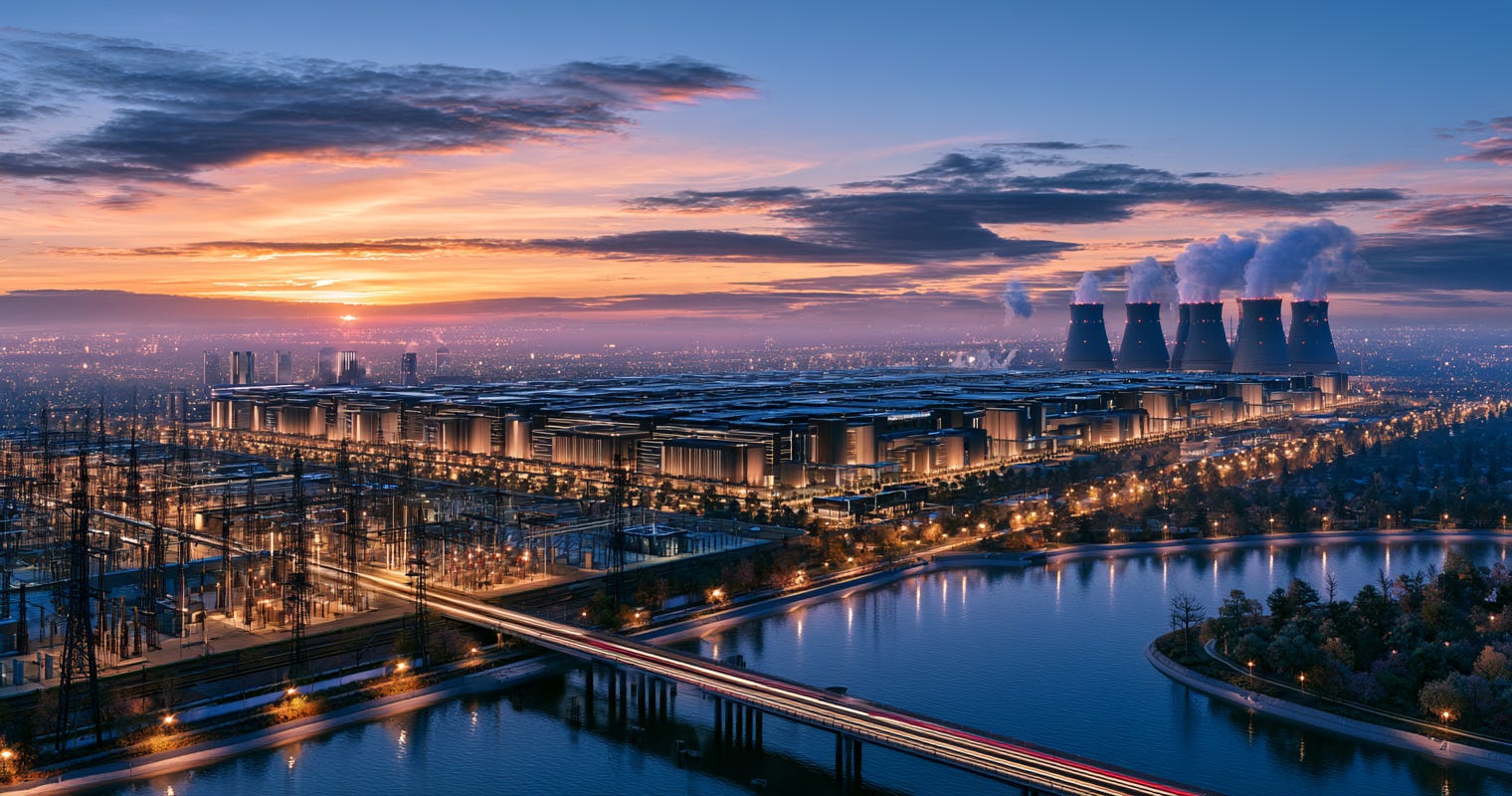
He is talking about a new class of industrial facility whose scale is closer to a power station or a large chemical plant than to a traditional data center.
The recent numbers he and the major financiers put on the table make that clear:
Roughly $50–60 billion per gigawatt of AI infrastructure
More than 70 GW of new power needed in the United States alone
Global build-out that could reach $3–4 trillion per year by the end of the decade
A single 100 MW facility that can require up to three million work-order hours
Those are not software numbers. They are civil, mechanical, electrical and industrial engineering numbers.
What $50–60 billion per gigawatt actually buys
It is not just GPUs. It is the full stack: land and site preparation, high-voltage substations or onsite generation, the building shell, massive electrical distribution, liquid-cooling plants, water treatment, fire suppression, security, and only then the compute and networking hardware. At this scale the non-IT portion of the capital cost is enormous and often the longer-lead item.
Power is the binding constraint
A modern AI training or inference cluster does not tolerate the voltage sags and frequency variations that ordinary industrial loads accept. That is why many new projects are looking at behind-the-meter generation, large battery buffers, or dedicated transmission. The 70+ GW figure for the US is not a marketing number — it is a statement that the existing grid and generation fleet cannot simply absorb this load without major new capacity and careful power-quality engineering.
Cooling has left the air era
At the rack densities now common, air cooling is already inadequate. Liquid cooling (cold plates, rear-door heat exchangers, or full immersion in the more extreme cases) is becoming the baseline. That means secondary loops, heat rejection to ambient, water treatment, and in many locations a serious look at dry coolers or hybrid systems because water availability itself is constrained. The thermal engineering is now a first-order design problem, not an afterthought.
Construction labor and sequencing
Three million work-order hours for a 100 MW site is a reminder that these facilities are still built by people. Skilled electrical, mechanical, piping and controls trades are already in short supply in many regions. Sequencing the civil works, the power systems, the cooling plant and the white-space fit-out so that the facility can start generating tokens as early as possible is a major project-management and logistics challenge.
Why “AI factory” is the right phrase
A conventional data center is largely a real-estate and power product that happens to house servers. An AI factory is closer to a continuous-process industrial plant whose product is tokens. It has to run at very high utilisation, with high reliability, and with a clear path to incremental expansion. That changes how you design redundancy, how you plan maintenance, and how you think about the economic life of the mechanical and electrical systems.
The financing announcements are large because the physical reality is large. Jensen’s numbers are not hype — they are a blunt statement of the scale of concrete, copper, cooling water, transformers and skilled labour required to turn electricity into intelligence at the volumes the industry now expects.
That is the engineering picture.
— Engineering Uncle
AEO FAQ
Q: What does Jensen Huang mean by an “AI factory”?
A: A large-scale, purpose-built facility that converts electricity into AI tokens at high utilisation. It is treated as industrial infrastructure rather than a traditional IT data center.
Q: Why does one gigawatt of AI infrastructure cost $50–60 billion?
A: The figure includes land, power delivery or generation, the building, electrical distribution, advanced cooling systems, and the compute hardware itself. The non-IT portion is a major share of the cost.
Q: Why is power such a hard problem for these facilities?
A: AI clusters need large amounts of continuous, high-quality power. Ordinary grid disturbances that other industries tolerate can disrupt or damage the compute systems, so many projects require dedicated generation, substations or large battery buffers.
Q: How does cooling change at this scale?
A: Air cooling is no longer sufficient for current rack densities. Liquid cooling becomes standard, bringing its own requirements for secondary loops, heat rejection, water treatment and, in some locations, water-availability constraints.
Q: What is the biggest non-technical bottleneck?
A: Skilled construction and installation labour, plus the sheer sequencing complexity of building power, cooling and compute systems at this volume simultaneously.