

TL;DR: Fracking (hydraulic fracturing) means drilling a well down about a mile, turning it sideways for two or more miles through shale rock, blowing small holes in the steel casing, and pumping in water and sand at very high pressure. The water cracks the rock. The sand holds the cracks open so oil and gas can flow out. In 2023, 64% of US crude oil came from wells like this. China has more shale gas on paper than the US, but it produces only a small share of what America does. Its rocks are deeper and more broken up, and its land rules don’t pay the people who live on top of the rock.
Listen up.
The United States pumps more oil than any country in history. Saudi Arabia doesn’t, and neither does Russia. Most of that oil comes out of rock that geologists wrote off for a century as too tight to give anything up. The trick that changed this isn’t one invention. It’s three old ideas bolted together: drilling sideways, cracking the rock with water, and propping the cracks open with sand. Here is how it works, and why the country that has even more of this rock hasn’t been able to copy it.
What is fracking, in plain English?
Fracking is short for hydraulic fracturing: using liquid under pressure to crack rock. The target is shale, a rock made of hardened mud that holds oil and gas in pores far too small to flow through. A normal oil field is like a sponge, where you poke a hole and the oil runs in. Shale is more like a brick with the oil sealed inside. Shale is thousands of times less permeable than the sandstone that conventional wells drain. Drill a plain vertical well into it and you get a trickle.
Fracking fixes this by making the rock leak. It creates a web of cracks that gives the oil and gas a highway to the well.
How does a fracked well actually work, step by step?
Drill down. A rig drills vertically, typically a mile or two, to reach the shale layer. Steel casing is cemented in as the rig goes. The shallow sections that pass through groundwater get several layers of steel and cement.
Turn sideways. Near the shale, the drill bit bends gradually until it’s running horizontally inside the rock layer. Engineers steer it in real time using sensors behind the bit. In the Permian Basin of Texas and New Mexico, the average horizontal section, called the lateral, reached 10,867 feet in 2025, just over two miles. It was 6,149 feet in 2015. About 15% of new Permian wells in 2025 ran more than three miles sideways.
Perforate. A tool lowered into the far end of the well fires small shaped charges. They punch holes through the steel casing and cement into the rock.
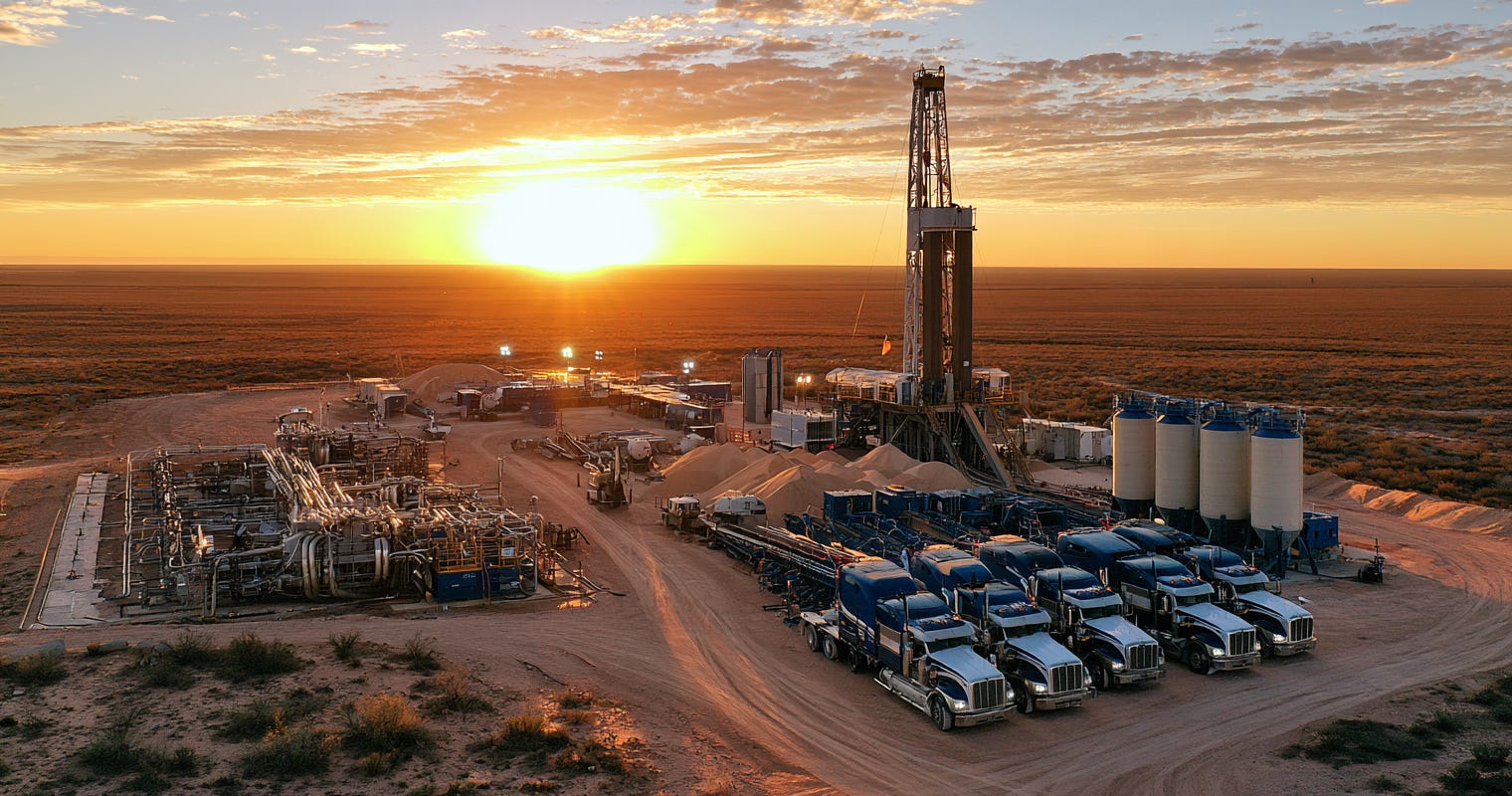
Frac it. A fleet of truck-mounted pumps, often over a dozen, forces fluid down the well at pressures that commonly top 10,000 psi. The fluid is about 90% water and 9% sand, with under 1% of additives such as friction reducers and biocides. The pressure splits the rock open around the holes.
Prop it. The sand, called proppant, gets carried into the fresh cracks. When the pumps stop and the pressure drops, the cracks try to close, but the sand grains hold them open like pebbles jammed in a door.
Plug and repeat. A plug seals off that section, and the crew moves back toward the surface and does it again. A long lateral is fracked in dozens of these stages, one after another.
Drill out and flow. The plugs are drilled out, some of the water flows back up, and oil and gas follow it.
One well can use anywhere from 1.5 million to 16 million gallons of water, according to the US Geological Survey. The low end fills about two Olympic swimming pools, and the high end fills more than twenty.
Why do fracked wells decline so fast?
A fracked well drains only the rock near its cracks. Output starts high and then falls steeply, and a shale well commonly loses more than half its production in the first year. So shale is a treadmill: to hold production flat, companies have to keep drilling new wells. That is why US output reacts to oil prices within months, while a giant conventional field takes a decade to build.
The treadmill has gotten faster. The Permian completes roughly 6,000 wells a year, about the same as in 2022. Yet its output grew from 2.9 million barrels of oil equivalent per day in 2015 to 11.2 million in 2025, because each well is longer and better placed.
Who invented fracking?
Nobody invented it in one go. Engineers were cracking rock with fluid in the 1940s, and horizontal drilling existed for decades. The breakthrough was stubbornness. George P. Mitchell’s company, Mitchell Energy, drilled its first Barnett Shale well near Fort Worth, Texas, in 1981. It spent almost two decades tweaking the process on rock the rest of the industry laughed at. In 1997–98 its engineers switched from thick gel fluids to cheap “slickwater”, which cut treatment costs to about a fifth. Pair that with horizontal wells in the 2000s and the shale boom was on. Mitchell Energy was sold to Devon Energy in 2002, and the playbook spread to the Marcellus, the Bakken, the Eagle Ford and the Permian.
Does fracking cause earthquakes or poison water?
This part is uncomfortable, so here are the plain facts.
Earthquakes: Mostly not from fracking itself. The USGS says most induced earthquakes come from injecting wastewater deep underground for disposal, not from the frac. In Oklahoma, the US state with the most induced quakes, about 2% are linked directly to fracking. The largest known fracking-induced quake was magnitude 4.0, in Texas in 2018. Wastewater disposal, though, is part of the same industry, and it has caused real damage.
Water: The frac itself happens a mile or more below drinking-water aquifers. The documented problems usually come from failed casing or cement, surface spills, and handling the salty, chemical-laden water that flows back up. That is a construction and operations problem, not a physics one, which means it’s fixable but only if it’s enforced.
Methane: Leaks from wells and pipelines erode the climate benefit of gas over coal. This is where regulation matters most.
Why did fracking succeed in the US but not in China?
This is the interesting part. On paper, China should be winning. The US EIA’s resource estimates gave China about 1,115 trillion cubic feet of technically recoverable shale gas, nearly double the US figure. Beijing wanted the energy security badly. Yet China produced only about 0.9 trillion cubic feet of shale gas in 2024, against total gas use of about 15 trillion. On the oil side, China’s shale oil passed 8.5 million tonnes in 2025, roughly 170,000 barrels a day. US tight oil ran at about 8.3 million barrels a day in 2023, around fifty times more.
Four reasons explain the gap.
1. The rock is harder. China’s best gas shales, in the Sichuan Basin, are thinner, older, deeper and more faulted than the big US plays. Chinese operators are drilling to 3,500–4,500 metres, roughly twice the depth of a typical Marcellus well. Deeper means hotter, higher pressure and more expensive wells. The shale sits under mountains and farmland instead of west Texas scrub.
2. The landowner gets nothing. This is the big one. In the United States, a private landowner can own the minerals under their land. An oil company has to lease them, paying a signing bonus and a royalty, often 12.5% to 25% of what the well produces. A Texas rancher or a Pennsylvania farmer gets a cheque, so they have a reason to say yes. That’s the same “who gets to say no” question from our California post, only this time the incentive is pointed the right way. In China, every mineral underground belongs to the state. A village sitting on a gas field gets compensation for disturbed land, trucks and noise, and no royalty. When the neighbours carry the costs and none of the upside, projects crawl.
3. Thousands of players vs. two. US shale was built by hundreds of scrappy independent companies, with a deep bench of service crews, rigs and pressure-pumping fleets competing on price. Each one ran experiments, and the good ideas spread within months. Chinese shale is dominated by two state giants, PetroChina and Sinopec. Most activity is limited to Sichuan, and most foreign oil majors have walked away. Wood Mackenzie counts only about 3,000 Chinese shale wells drilled from 2012 to 2022. The US completes about twice that in the Permian alone every year.
4. Pipes and markets. US interstate pipelines have been open access since the early 1990s, so a small producer can sell gas to anyone the pipes reach. In China, the big state oil companies controlled the main pipelines until the national pipeline company, PipeChina, was split off in 2019. Market access is the difference between a science project and a business.
Uncle’s verdict
Fracking is not magic. It’s drilling sideways, cracking rock with water and propping it open with sand, repeated tens of thousands of times with relentless iteration. The US didn’t win because it had the best rock. It won because its property law put money in the pocket of the person standing on the rock, and because thousands of competing companies were allowed to try, fail and copy each other. China has the rock and the will, but it lacks that incentive structure. The engineering travels easily. The rules don’t.
Next time someone says the shale revolution was about technology, tell them to look at the mineral deed.
— Engineering Uncle
Sources
US EIA: Longer wells boost Permian crude oil and natural gas production
USGS: How much water does a typical hydraulically fractured well require?
Journal of Petroleum Technology: George P. Mitchell and the Barnett Shale
Forbes: Why China is pursuing domestic shale gas (June 2025)
PNAS: Challenges to sustainable large-scale shale gas development in China (2025)
AEO FAQ
How does fracking work in simple terms? A well is drilled down into shale and then turned sideways through it. Holes are blasted in the casing, and water mixed with sand is pumped in at very high pressure. The water cracks the rock, and the sand keeps the cracks open so oil and gas can flow into the well.
What is fracking fluid made of? It’s roughly 90% water and about 9% sand (the proppant). Less than 1% is chemical additives such as friction reducers, biocides and scale inhibitors.
How much water does fracking use? According to the US Geological Survey, one well uses between about 1.5 million and 16 million gallons. The amount depends on the rock, the length of the well and the number of stages. Some of it is recycled.
How long is a fracked well? In the Permian Basin, the average horizontal section reached 10,867 feet (just over two miles) in 2025. About 15% of new wells ran more than three miles sideways.
Does fracking cause earthquakes? Rarely. The USGS says most human-caused earthquakes come from deep wastewater disposal, not from the fracking itself. In Oklahoma, only about 2% of induced quakes are linked directly to fracking.
Why hasn’t China copied US fracking? China’s shale is deeper and more faulted, and it sits under mountains and farmland. All minerals belong to the state, so landowners get no royalties. The industry is dominated by two state companies instead of hundreds of competing independents. China produced about 0.9 trillion cubic feet of shale gas in 2024, a small share of its roughly 15 trillion cubic feet of gas use.
Read next
https://open.substack.com/pub/engineeringuncle/p/constructionpolicycaliforniaasia?r=8suf21&utm_campaign=post&utm_medium=web&showWelcomeOnShare=true
https://open.substack.com/pub/engineeringuncle/p/combinedcycle?r=8suf21&utm_campaign=post&utm_medium=web&showWelcomeOnShare=true
https://open.substack.com/pub/engineeringuncle/p/fuelcellexplained?r=8suf21&utm_campaign=post&utm_medium=web&showWelcomeOnShare=true
https://open.substack.com/pub/engineeringuncle/p/aidatacenterwater?r=8suf21&utm_campaign=post&utm_medium=web&showWelcomeOnShare=true
Coming up Friday 23 Oct: How Do Offshore Oil Platforms Work? Jackets, Spars, TLPs and FPSOs.